28-Day Pilates Challenge Guide
<p>Pilates is having a moment. A 2025 Sports & Fitness Industry Association report says U.S. participation has jumped nearly 40 percent since 2019, reaching 12.9 million people in 2024. On TikTok…
- Published
- Written by
- Women In Balance Team
- Reading time
- 14 minutes
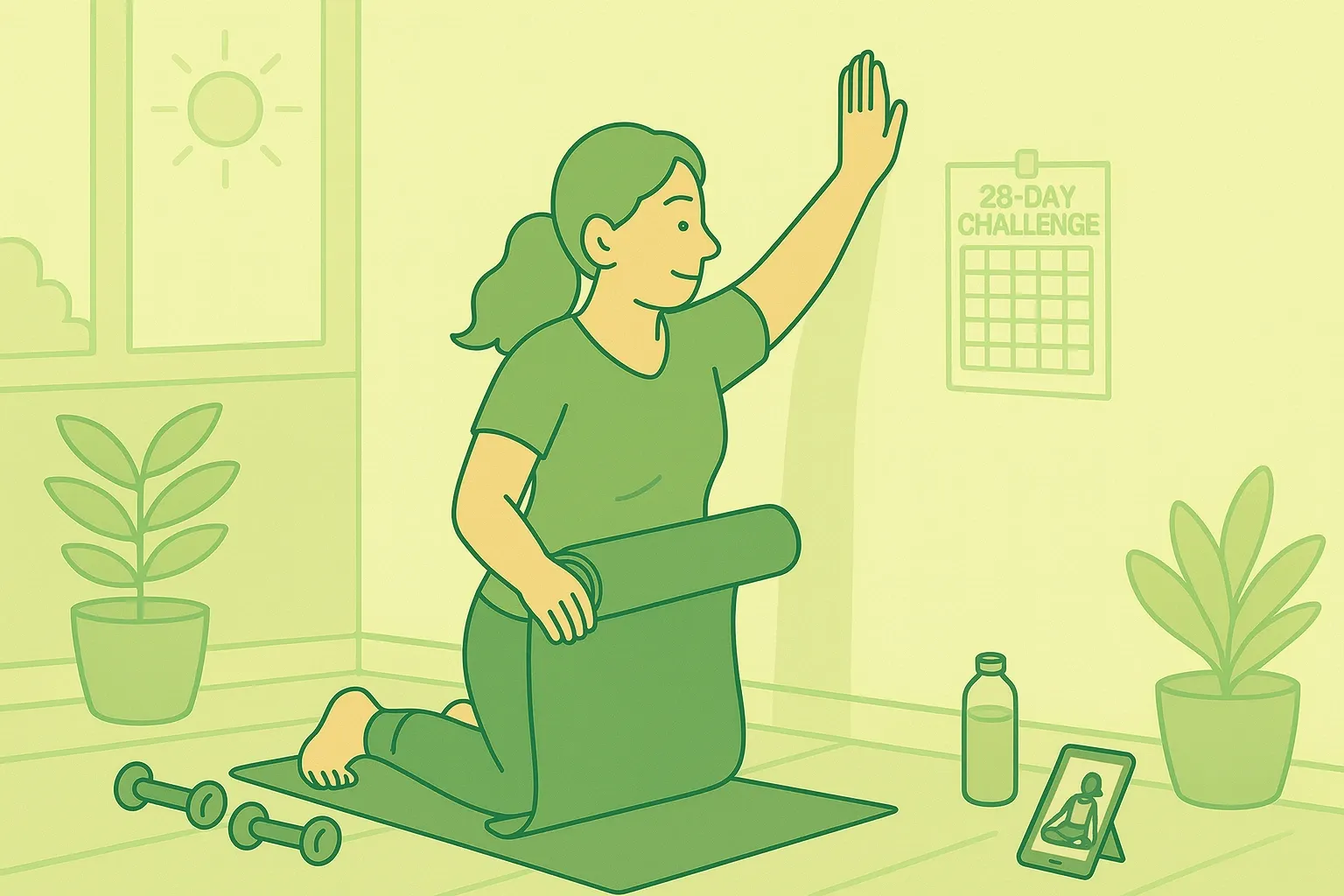
Pilates is having a moment. A 2025 Sports & Fitness Industry Association report says U.S. participation has jumped nearly 40 percent since 2019, reaching 12.9 million people in 2024. On TikTok, videos tagged with the 28-day wall-Pilates challenge now top 50 million views, turning a month-long routine into a bona-fide trend, according to Marie Claire.
Why 28 days? Four weeks are long enough to hard-wire a habit yet short enough to keep motivation high. In this guide, you’ll see exactly what gear, budget, schedule, and results to expect—so you can decide if a daily Pilates calendar is your next power move.
Why Pilates? The gains you feel in four weeks
Pilates looks gentle, yet it delivers serious dividends. Each session recruits deep stabilizer muscles—your abs, glutes, and the tiny posture-keepers along the spine—without the joint pounding that comes with high-impact workouts.
Because the moves stay low-impact, you can train nearly every day, avoid crippling soreness, and build a compound effect that turns four weeks into visible change. All you need is a wall and ten minutes to transform your body with Wall Pilates, a 28-day plan that layers progressive sessions without pricey gear.
What the research shows:
- In a randomized study of women aged 60–65, mat Pilates three times a week for eight weeks boosted VO₂ max by 48 percent and lowered anxiety scores by 53 percent, according to research catalogued on PubMed. Early aerobic gains often appear by week four, so you’ll feel progress before the study’s finish line.
- A separate trial reported that just four weeks of low-intensity mat Pilates twice weekly shifted participants’ lactate threshold, meaning their bodies used oxygen more efficiently during everyday movement, according to findings published in the Journal of Sports Medicine.
What does that feel like off the mat?
- Stronger core muscles lift posture, so you sit taller at the laptop and haul groceries without a twinge.
- Rhythmic breathing calms the nervous system, smoothing out afternoon stress spikes.
- Functional strength, not bulk, makes real-world tasks—from buckling a seat belt to hoisting a toddler—easier.
That mix of strength, flexibility, and calm is why this 28-day calendar centers on Pilates. The goal isn’t just to look different; it’s to move, stand, and live better—four weeks from now and for the long haul.
What does a 28-day Pilates workout challenge look like?
Think of the plan as a four-row calendar, one week per row, seven daily squares. Most popular challenges schedule six workouts and one rest day each week, a cadence that balances progression and recovery.
How the four-week calendar works
| Week | Focus | Typical session length* |
| 1 | Fundamentals, breath, alignment | 10–15 min |
| 2 | New moves, light props | 15–20 min |
| 3 | Flow circuits, balance drills | 20–25 min |
| 4 | Full-body sequences, stamina push | 25–30 min |
Durations match the BetterMe 28-Day Wall-Pilates schedule, which starts at 10–15 minutes and tops out around 25–30 minutes by week four.
The gradual climb lets muscles adapt without burnout while giving a clear marker of progress: each block lasts a bit longer, and your body grows stronger. Tick off each square after finishing; the visual chain of wins reinforces motivation.
1. Clear space and a supportive surface
Claim a rectangle at least 6 × 3 feet (about 180 × 90 cm), enough to lie flat with arms stretched overhead and swing a leg without clipping furniture. WallPilates home-setup guide plots the same footprint—six feet of wall length plus about four feet of clearance on each side—showing that the only essentials are a wall and a mat. Hardwood, carpet, or tile all work if nothing blocks the line of sight to the screen.
Unroll a yoga or Pilates mat for grip and cushioning. Budget models such as the BalanceFrom GoYoga 71-inch mat retail for about $18. The mat acts as a visual cue: once it is down, it is workout time.
Scan the nearest wall. The plan leans against it for alignment drills later, so clear picture frames and allow a foot of sweep space on each side.
2. Minimal equipment
Pilates thrives on simplicity; your body supplies most resistance, so gadgets remain optional.
Extra challenge options:
- Light dumbbells (2–3 lb / 1–1.5 kg); soup cans work in a pinch.
- Loop or tube resistance bands. A five-band set such as Insonder costs about $7 and covers 10–40 lb of tension, according to Verywell Fit.
- Mini Pilates ball (≈9 in / 23 cm). The Theraband Mini Ball lists for about $15 and boosts core engagement when placed behind the back or between the knees, according to Verywell Fit.
Shop after confirming regular use beyond day 28; clutter can derail consistency. A mat is the lone non-negotiable; everything else is nice to have.
3. Comfortable attire
Choose clothes that move with you and make alignment easy to spot. Leggings or bike shorts that hug rather than squeeze and a moisture-wicking top that stays put in planks keep focus on form. Loose tees can hide spinal alignment.
Pilates is often barefoot. If the floor feels slick, grip socks add traction. Basic pairs such as Gaiam’s Grippy Yoga Socks start at about $8, while LA Active sells a three-pair pack for about $20, notes Self magazine.
4. A daily appointment with yourself
Block 20–30 minutes on the calendar, enough to open the video, unroll the mat, and finish the routine. Treat it like any other meeting. Research from University College London links consistent cues to faster habit formation.
Pick a natural slot—sunrise energy boost or an evening scroll swap—and guard it. The calendar includes six workouts and one rest day per week; use the rest day for a walk, stretch session, or reflection.
5. Motivation and simple tracking
Print the 28-day calendar or set it as phone wallpaper. After each workout, mark a bold X and jot one quick stat, for example “Plank 45 s” or “Mood 9/10.” A 2016 tracker study found consistent logs linked to 0.6 percent more body-weight loss per month than no tracking, according to the American Journal of Medicine.
Accountability tools keep the streak alive. Apps that reimagine progress tracking such as Hoola fitness app, where every completed class earns experience points toward Strength, Flexibility, and Mindfulness, turn each workout into a small win. Seeing the XP bar fill taps the brain’s reward circuitry, and gentle reminders plus leaderboards deliver the same social-feedback boost that experiments in the Journal of Behavioral Medicine link to higher completion rates.
Keep perspective—every tick on the calendar is an act of self-care. Day 28 delivers proof that steady action compounds into strength, posture, and calm.
1. Why an at-home challenge saves real money
Studio Pilates feels luxurious, but the bill tells a different story. ClassPass lists reformer sessions in major U.S. cities at $20–$65 each, with an $85 national average drop-in price. Five visits a week racks up $340–$1,300 per month.
An at-home calendar flips the math. Your fixed expense is a $20 mat; videos live on YouTube or inside low-cost apps. Even premium platforms such as Pilates Workout at Home run $4.99–$9.99 per month, and higher-touch apps like Pilates Project top out at $34.99.
Bottom line: trading the studio for living-room workouts can keep several hundred dollars in your pocket while delivering the same core strength, flexibility, and stress relief.
2. Equipment you may—or may not—buy
A sturdy mat (around $20 on Amazon) is the only must-have. Everything else sits in the nice-to-have column:
- Loop resistance bands. A five-band set such as Insonder covers 10–40 lb of tension and costs about $7, according to Verywell Fit.
- Mini Pilates ball (9 in / 23 cm). Theraband’s best-in-test mini ball lists for about $14 and boosts core work when placed behind the back or between the knees, per Verywell Fit.
- Light dumbbells (2–3 lb / 1–1.5 kg). Expect $10–$15 per pair at most big-box retailers.
Begin the challenge with body-weight moves. After testing every exercise, decide if a $15 prop adds value. Buying later keeps closets clear and budgets intact.
3. Hidden extras worth noting
A few small expenses can creep in:
- Food upgrades. If your program includes a recipe guide, plan for a modest grocery bump. The USDA reports food-at-home prices rose 1.2 percent in 2024, or roughly $6 on a $500 monthly shop.
- Printouts. Ink and paper for calendars or progress sheets cost under $2 for 20 black-and-white pages.
- Music streaming. Ad-free playlists on Spotify Premium run $11.99 per month in the United States.
None of these extras are mandatory. Think of them as seasoning, not the entrée. Set aside $10–$20 for convenience touches and skip anything that feels like clutter; the real investment is your effort, not your credit card.
Safety guidelines and preparing for the challenge
- Get the medical green light. If you are pregnant, managing a chronic condition, or returning from injury, schedule a quick check-in with your doctor or physical therapist. The American College of Sports Medicine recommends medical clearance for anyone with symptoms or risk factors before starting daily exercise.
- Listen to your body, not your ego. Pilates prizes precision over speed. Mild muscle fatigue is fine; sharp joint pain means stop. Aim for 3–4 out of 10 on the discomfort scale during the first week, and increase intensity gradually.
- Master the “big three” cues before day 1.
- Neutral spine. Lie on your back and keep a natural lumbar curve without arching.
- Tabletop legs. Knees over hips, shins parallel to the ceiling, abs braced.
- Pilates breath. Inhale into the sides of the ribs, and exhale while drawing the navel toward the spine.
Five minutes of rehearsal now prevents form drift when the pace picks up.
- Pace and recover. The calendar includes one rest day each week. Use it for walking or gentle stretching. Sleep 7–9 hours; growth hormone peaks overnight and repairs micro-tears, trimming injury risk by up to 30 percent in regular exercisers, according to the National Institutes of Health.
Lock in these protocols, and you reach day 28 feeling stronger and injury-free.
Week 1 – foundations and form
Think of the first seven days as Pilates 101. Keep each session to 10–15 minutes, long enough to wake up core and postural muscles without overload. The BetterMe Wall-Pilates plan mirrors this cadence, focusing on wall roll-downs, bridges, and planks during its foundation week.
Goals for week 1
- Nail the basics: pelvic tilts, wall bridges, spine stretches, tabletop holds.
- Pair every move with slow diaphragmatic breathing.
- Aim for “good” soreness in lower abs and inner thighs while keeping joints pain-free.
Celebrate small wins, such as a smoother roll-down or a plank held five seconds longer, and let each success reinforce the habit you are building.
Week 2 – stepping it up
The mat feels like home now, so it increases both time and variety. Many 28-day plans, including the BetterMe Wall-Pilates challenge, stretch sessions to 18–25 minutes and add:
- Plank variations such as forearm plank taps and side planks.
- Side-lying leg lifts for glutes and hips.
- Band-assisted arm pulses that light up the upper body.
Expect extra sweat from faster transitions, not from impact. This steady pace moves heart rate to 60–70 percent of maximum, the moderate-intensity zone that builds endurance while protecting joints.
By day 14 muscles tire less and posture perks up. Shoulders drop, the core engages automatically when you carry groceries, and momentum feels natural. Keep showing up to bank these gains.
Week 3 – finding your strength
Welcome to the midpoint, where grit meets payoff. Sessions now run 28–32 minutes, weaving in faster transitions, mini cardio bursts, and balance drills such as standing leg sweeps or teaser preps.
These brisk intervals push heart rate to 70–85 percent of maximum, the vigorous-intensity range the American Heart Association links to fitness gains. Core muscles that once trembled now engage on demand; planks exceed a minute, and flows connect without extra breaths.
Visible changes appear: a trimmer waist, lifted glutes, and an urge to stand taller. Motivation can dip, so lean on your calendar chain or challenge buddy. Show up each day and week 3 shifts from hurdle to high-five.
Week 4 – peak and celebrate
The final stretch blends everything learned into flowing 28–32-minute sequences that test stamina without tipping into strain. Expect compound moves such as plank-to-pike, side-plank leg raises, and rolling teasers that link strength, balance, and flexibility in one continuous groove.
Progress shows quickly. Core muscles engage before conscious thought, and breathing syncs with movement like second nature. Re-measure key markers now: hold a plank for 90 seconds, reach two inches farther in a hamstring stretch, or zip favorite jeans without a shimmy. Numbers matter, yet the confidence behind them matters more.
Day 28 ends with a reflective cooldown. Look back to day 1, see every bold X, and recognize the foundation built in four weeks. That pride fuels momentum, and research from University College London finds habits start to feel automatic after about 66 days. Use this win as a launchpad for the next goal.
Realistic outcomes: results you can expect in 28 days
Below are common changes beginners report within a month, each tied to early-phase Pilates research. Genetics, nutrition, and workout consistency all affect the pace.
Strengthened core and toned muscles
A randomized trial of women who practiced mat Pilates three times a week recorded a 43 percent jump in curl-up endurance and a 2 cm drop in waist circumference by week 6, according to research archived on PubMed. Expect the transverse abdominis to switch on automatically when you stand, sit, or lift.
Increased flexibility and improved posture
The same study reported a 15 percent gain in sit-and-reach flexibility after six weeks. Daily roll-downs and hamstring stretches loosen tight hips and shoulders, allowing you to sit taller and breathe easier at a desk.
Subtle weight or inch loss
Pilates is not a calorie inferno, yet daily movement builds metabolically active muscle. Participants in an eight-week program dropped an average 1.4 lb and 0.8 in off the waist without diet changes, according to Sports Health journal. Clothes fit better even when the scale shows little change.
Enhanced balance and everyday stability
A controlled trial found static balance scores improved 18 percent after six weeks of Pilates. Steadier ankles and hips make stairs and curbs feel easier.
Higher energy and calmer mind
Pilates pairs rhythmic breathing with moderate-intensity effort, which can raise VO₂ max and lower anxiety scores within eight weeks, according to Clinical Rehabilitation. Many users notice fewer afternoon slumps and deeper sleep by week four.
Support for hormones and mood
Midlife women in eight-week mat studies showed reduced cortisol peaks, better insulin sensitivity, and stronger pelvic-floor engagement, reports the Journal of Women’s Health. A month marks an early step toward steadier moods and lighter PMS.
Confidence and habit momentum
Marking each workout on the calendar builds a new identity: someone who shows up. Habit research suggests repetition in a consistent context turns effort into autopilot after about 66 days. Your 28-day streak lands at the halfway point.
Tips to maximize success during the challenge
Pair Pilates with smart nutrition. Aim for 1.2–1.6 g of protein per kilogram of body weight, the range endurance and strength experts recommend for active adults. Fill half the plate with colorful produce and sip 17–20 oz of water two hours before class, plus 7–10 oz every 20 minutes during; these figures match the American Council on Exercise’s baseline hydration guidance. Treat the 20-minute workout like any other meeting, and if life intervenes, move it to tomorrow instead of doubling up. Consistency beats perfection.
Focus on form, not reps. Pilates rewards precision. Record a short clip or use a mirror to check shoulder height and lumbar curve. Quality repetitions recruit more muscle fibers and protect joints.
Recovering is like part of training. Sleep 7–9 hours; insufficient rest impairs muscle repair and mood regulation, according to NIH research. Add five minutes of foam rolling or static stretching most evenings to keep tissues supple.
Keep it interesting. Swap instructors or add a playlist on days when motivation dips. Micro-goals, such as holding planks five seconds longer or perfecting a teaser, create quick wins.
Lean on the community. A randomized trial found social accountability lifts exercise adherence by up to 35 percent over solo tracking. Post a green checkmark on social media or text a buddy; outside eyes keep the streak alive.
Lock in these habits and the 28-day calendar becomes more than a challenge—it becomes a springboard for long-term Pilates practice.
Conclusion
Four focused weeks of Wall Pilates can transform far more than your core. By committing just 10–30 minutes a day, you’ll hard-wire a sustainable exercise habit, strengthen stabilizer muscles, and sharpen mind-body awareness without punishing your joints. The minimalist gear list keeps barriers low while science-backed progressions ensure steady, measurable gains. Track each workout, honor rest days, and tweak intensity to match your energy. Whether your goal is stronger posture, enhanced mobility, or the confidence that comes from showing up for yourself, this 28-day challenge lays the groundwork for a lifetime of movement. Now unroll the mat, press play, and turn today into day one of a stronger you.
Frequently asked questions
1. I’m not very fit—can I still do this challenge?
Absolutely. The calendar opens with beginner-friendly flows and offers modifications for every move. In fact, a study on previously sedentary adults showed a 43 percent gain in core endurance after six weeks of basic mat Pilates, so beginners often improve the fastest.
2. What happens if I miss a day?
Just resume the program on the next calendar square—the finish date can slide. Habit research shows that overall consistency matters more than an unbroken streak; one skipped session won’t erase your earlier gains.
3. Can Pilates alone support weight loss?
On its own, Pilates delivers modest fat-loss results (about 1–2 lb over eight weeks in clinical trials). Pairing the workouts with balanced nutrition and a daily step goal amplifies calorie burn and accelerates body-composition changes.
4. Is Pilates enough exercise on its own?
Daily mat sessions cover strength, flexibility, and low-impact cardio for many people. For lifelong health, the American College of Sports Medicine still recommends 150 minutes of moderate aerobic activity per week plus bone-loading exercise such as brisk walking or light weights.
5. What should I do after the 28-day finish line?
Celebrate, then set a fresh goal: repeat the calendar with heavier bands, drop to three Pilates sessions and add cycling, or try a live reformer class for variety. Momentum thrives on purposeful next steps.