How Long After Implantation Does hCG Rise? Timeline & Tests
<p>hCG levels begin to rise about 6 to 12 days after implantation. Blood tests can detect hCG as early as 11 days post-ovulation, while urine tests typically detect it around 14 days. The hormone…
- Published
- Written by
- Women In Balance Team
- Reading time
- 9 minutes
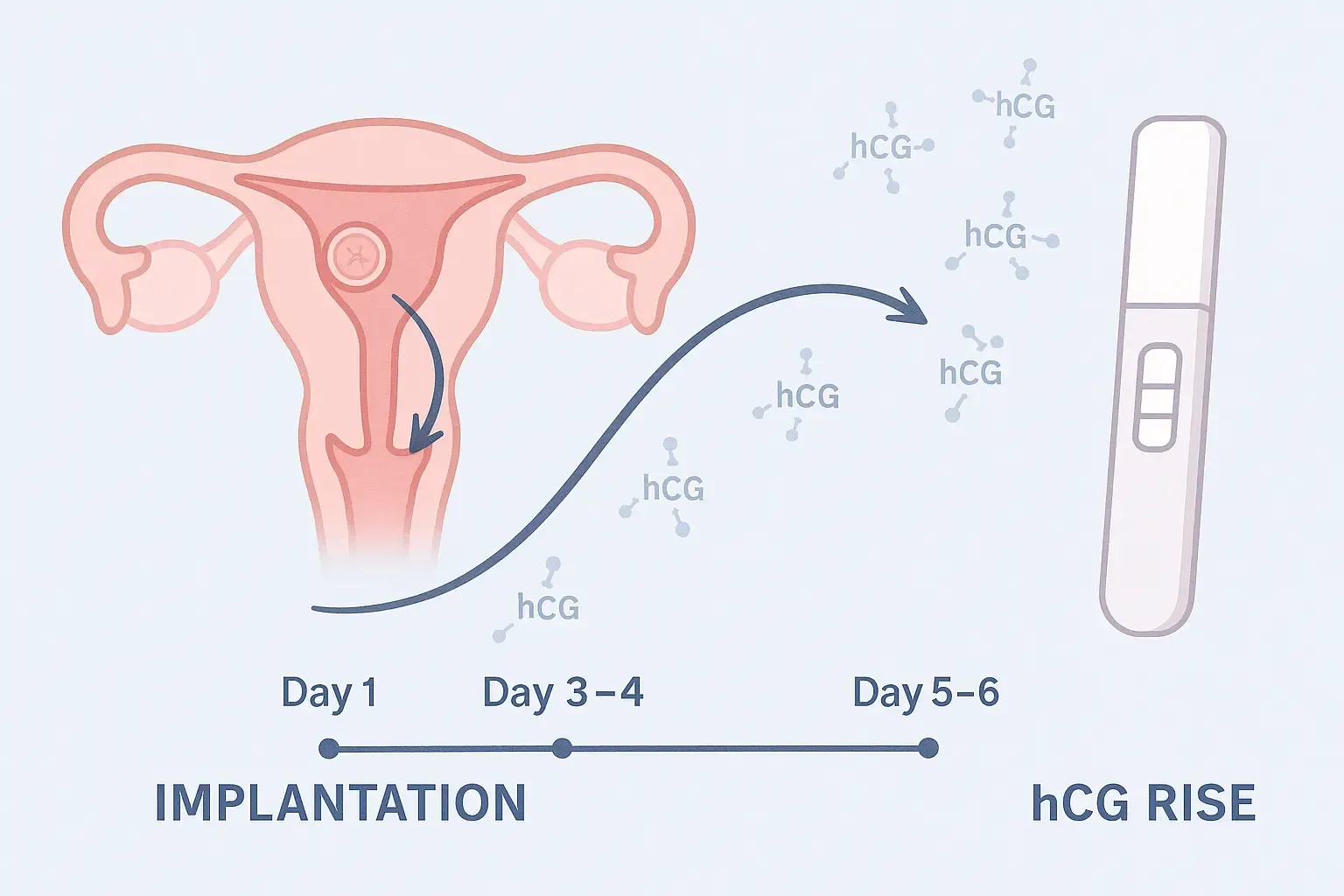
hCG levels begin to rise about 6 to 12 days after implantation. Blood tests can detect hCG as early as 11 days post-ovulation, while urine tests typically detect it around 14 days. The hormone doubles every 48–72 hours in early pregnancy, confirming implantation and pregnancy.
Key Takeaways
- hCG begins rising 1-2 days after implantation – The hormone starts being produced immediately when the embryo attaches to the uterine wall
- Detectable levels appear 3-4 days post-implantation – Most sensitive pregnancy tests can detect hCG around this timeframe
- Doubling occurs every 48-72 hours – Normal early pregnancy shows rapid hCG increases, doubling approximately every 2-3 days
If you’re anxiously waiting to find out whether you’re pregnant, understanding the timing of early pregnancy hormones can help you know when to test for the most accurate results. The question of how long after implantation does hCG rise is crucial for anyone trying to conceive, as it determines when pregnancy tests will be reliable. This hormone, produced only during pregnancy, serves as the earliest detectable sign that conception has occurred. Getting the timing right can save you from the disappointment of false negative tests and help you get accurate results when you’re ready to know for certain.
What Is Implantation?
Implantation is the critical process where a fertilized embryo attaches itself to the lining of your uterus, officially beginning pregnancy. This remarkable biological event typically occurs 6-12 days after ovulation, with most implantations happening around 8-10 days post-ovulation.
During implantation, the embryo – now called a blastocyst – burrows into the thickened uterine lining (endometrium) that your body has prepared during your menstrual cycle. This process usually takes 2-3 days to complete fully, during which the embryo establishes the crucial connection with your blood supply that will sustain the developing pregnancy.
Common implantation signs may include light spotting or bleeding (called implantation bleeding), mild cramping on one side, a slight temperature dip on your basal body temperature chart, or increased cervical mucus. However, many women experience no noticeable symptoms during implantation, so the absence of signs doesn’t mean implantation hasn’t occurred.
Timing variations are normal and depend on several factors, including when ovulation occurred, how quickly the embryo developed, and individual biological differences. Earlier implantation (around day 6-7) may occur with faster-developing embryos, while later implantation (day 10-12) is still completely normal and doesn’t indicate any problems with the pregnancy.
The implantation process is what triggers the production of pregnancy hormones, making it the pivotal moment that determines when pregnancy tests will become positive.
What Is hCG and Why It Matters?
Human chorionic gonadotropin (hCG) is often called the “pregnancy hormone” because it’s produced exclusively during pregnancy and serves as the primary marker that pregnancy tests detect. This hormone plays a vital role in maintaining your pregnancy during the crucial early weeks.
hCG production begins as soon as the embryo successfully implants in your uterine lining. The outer layer of the embryo, called the trophoblast, starts secreting hCG into your bloodstream immediately upon attachment. This hormone then travels throughout your body, including into your urine, where pregnancy tests can detect it.
Primary functions of hCG include maintaining the corpus luteum (the structure that produces progesterone after ovulation), preventing your menstrual period, and supporting the early development of the pregnancy until the placenta can take over hormone production around 8-10 weeks.
Detection methods rely on hCG’s presence in both blood and urine. Blood tests can detect lower levels of hCG than urine tests, making them more sensitive for very early detection. However, home pregnancy tests that detect hCG in urine are more convenient and still highly accurate when used at the right time.
Understanding hCG is crucial because this hormone’s rise and pattern can provide important information about pregnancy health, timing, and viability during the early weeks when other signs may not yet be apparent.
How Long After Implantation Does hCG Rise?
The timing of hCG rise after implantation follows a predictable pattern that’s crucial for understanding when pregnancy tests will be accurate.
Immediate production begins within 24-48 hours of successful implantation. As soon as the embryo attaches to your uterine lining, the trophoblast cells start producing hCG. However, these initial levels are very low and may not be detectable by standard pregnancy tests.
Detectable levels typically appear 3-4 days after implantation for the most sensitive pregnancy tests. This means if implantation occurs on day 8 after ovulation, hCG might be detectable by day 11-12 after ovulation. However, levels may still be too low for less sensitive tests at this early stage.
Rapid doubling is the hallmark of early pregnancy hCG patterns. Once production begins, hCG levels approximately double every 48-72 hours during the first several weeks of pregnancy. This rapid increase means that even if levels are too low to detect one day, they may be clearly positive just 2-3 days later.
Peak detectability for home pregnancy tests usually occurs 12-14 days after ovulation, assuming normal implantation timing. By this point, hCG levels have had sufficient time to rise to levels that even moderately sensitive tests can reliably detect.
The key insight is that while hCG production begins almost immediately after implantation, it takes several days for levels to rise high enough for accurate detection by pregnancy tests.
Factors That Affect hCG Rise
Several biological and situational factors can influence how quickly hCG levels rise after implantation, leading to variations in when pregnancy tests become positive.
Multiple pregnancies (twins, triplets, or higher multiples) typically produce higher hCG levels that rise more rapidly than single pregnancies. Women carrying multiples may get positive pregnancy tests earlier than expected and will generally have higher hCG numbers throughout early pregnancy.
Implantation timing significantly affects when hCG becomes detectable. Earlier implantation (day 6-7 after ovulation) means hCG production starts sooner, potentially leading to positive tests as early as 10-11 days after ovulation. Later implantation (day 10-12) delays hCG production, meaning positive tests may not appear until 14-16 days after ovulation.
Individual hormone sensitivity varies between women. Some women’s bodies produce hCG more rapidly or in higher quantities than others, while some may have slower initial rises that still represent completely normal pregnancies. Age, overall health, and individual metabolism can influence these patterns.
Ectopic pregnancies often produce hCG at slower rates than normal intrauterine pregnancies. While hCG will still rise, the pattern may be less predictable, with slower doubling times or plateauing levels. This is why healthcare providers monitor both hCG levels and their rate of increase in early pregnancy.
Chemical pregnancies represent very early pregnancy losses where implantation occurs and hCG production begins, but the pregnancy doesn’t continue to develop. These may cause brief positive pregnancy tests followed by negative tests and a late period.
Medications like fertility drugs containing hCG can interfere with pregnancy test accuracy, potentially causing false positive results if taken within 7-14 days of the trigger shot.
Best Practices for Accurate Testing
Optimizing your pregnancy testing approach can help ensure accurate results and reduce the likelihood of false negatives or confusion about timing.
Timing recommendations suggest waiting at least 12-14 days after ovulation for the most reliable results with standard home pregnancy tests. If you know your implantation date, waiting 4-5 days after implantation gives hCG levels time to rise to detectable levels.
First morning urine provides the most concentrated hCG levels and reduces the chance of false negative results. Your first urination of the day contains hCG that has accumulated overnight, making it easier for tests to detect even moderate levels of the hormone.
Test sensitivity matters significantly for early testing. Tests labeled as detecting 25 mIU/mL hCG are more sensitive than those detecting 50 mIU/mL or higher. More sensitive tests can detect pregnancy earlier, though they may also be more prone to very faint positive lines that can be difficult to interpret.
Progressive testing approach works well for early detection attempts. If you get a negative result but suspect you might be pregnant, wait 2-3 days and test again. hCG’s rapid doubling means that a negative test can become clearly positive within just a few days.
Avoid excessive early testing to prevent disappointment and confusion. Testing too early (before 10-12 days after ovulation) often results in false negatives simply because hCG levels haven’t had time to rise sufficiently, not because pregnancy hasn’t occurred.
Digital vs. line tests each have advantages. Digital tests eliminate the guesswork of interpreting faint lines but are generally less sensitive than traditional line tests. Line tests can detect pregnancy earlier but require interpretation of sometimes very faint positive lines.
Sample hCG Level Ranges by Week
Understanding typical hCG levels throughout early pregnancy can help you interpret test results and understand what’s normal for your stage of pregnancy.
3 weeks pregnant (1 week after conception): 5-50 mIU/mL
- This is when most sensitive tests begin detecting pregnancy
- Levels are often still quite low and may produce faint positive lines
4 weeks pregnant (2 weeks after conception): 25-400 mIU/mL
- Most home pregnancy tests will show clear positive results
- Wide normal range reflects individual variation in hCG production
5 weeks pregnant (3 weeks after conception): 200-7,000 mIU/mL
- Rapid rise continues with significant doubling every 48-72 hours
- Most women will have strong positive pregnancy tests at this stage
6 weeks pregnant (4 weeks after conception): 500-18,000 mIU/mL
- hCG levels are now high enough to maintain pregnancy hormones
- Range continues to widen as individual variations become more pronounced
7-8 weeks pregnant: 1,000-50,000 mIU/mL
- Peak hCG production period for most pregnancies
- Levels may begin to plateau or even decrease slightly after this point
Important considerations about these ranges include that they’re averages and normal pregnancies can fall outside these ranges while still being completely healthy. What matters more than absolute numbers is the pattern of increase – healthy pregnancies should show appropriate doubling every 48-72 hours during the first 6-8 weeks.
Individual variation is significant, and comparing your specific levels to others isn’t helpful. Some women naturally produce higher or lower hCG levels while having perfectly normal pregnancies.
Conclusion
Understanding how long after implantation hCG rises empowers you to time your pregnancy testing for the most accurate results and reduces unnecessary anxiety during the early waiting period. The key timeline to remember is that hCG production begins 1-2 days after implantation, reaches detectable levels 3-4 days after implantation, and doubles rapidly every 48-72 hours in healthy early pregnancies.
While the science provides general timelines, remember that individual variation is normal and healthy pregnancies can follow slightly different patterns. The most important factors are using sensitive tests, timing them appropriately, and understanding that very early testing may require patience as hCG levels rise to detectable ranges.
Take action today by tracking your cycle carefully if you’re trying to conceive, so you can identify your likely implantation window and plan your testing timeline accordingly. If you get confusing results or have concerns about your hCG patterns, consult with your healthcare provider who can offer personalized guidance and potentially order blood tests for more precise hormone monitoring.
Frequently Asked Questions
How soon after implantation will you test positive?
Most women will test positive 3-5 days after implantation with sensitive pregnancy tests. Since implantation typically occurs 8-10 days after ovulation, this means positive tests usually appear 11-15 days after ovulation. Using first morning urine and a test sensitive to 25 mIU/mL or lower improves your chances of early detection.
Can a pregnancy still be viable with slow-rising hCG levels?
Yes, pregnancies with slower hCG rises can still be viable, though they require monitoring. While normal hCG doubles every 48-72 hours, some healthy pregnancies have slightly slower doubling times of 72-96 hours. However, consistently slow rises, plateauing levels, or declining hCG may indicate potential problems and warrant medical evaluation.
How many days after ovulation can you take a pregnancy test?
The earliest you can reasonably expect a positive pregnancy test is 10-12 days after ovulation, though 14 days provides more reliable results. This timing allows for implantation to occur (6-12 days post-ovulation) and hCG levels to rise sufficiently for detection. Testing earlier often results in false negatives simply due to timing, not absence of pregnancy.