Faint Positive vs. Evaporation Line: Key Differences
Key Takeaways You take a pregnancy test, wait a few minutes, and then stare at the result window. There’s a line, but it’s faint. Barely there. Your heart races as you tilt it under different lights…
- Published
- Written by
- Women In Balance Team
- Reading time
- 10 minutes

Key Takeaways
- A faint positive line shows visible color (pink or blue) and appears within the test’s recommended reading window, usually 3–5 minutes.
- An evaporation line is colorless, grey, or white and only shows up after the test has dried, typically 10 or more minutes after testing.
- If your result is unclear, wait 24–48 hours and retest with first-morning urine or a digital pregnancy test for a more definitive answer.
You take a pregnancy test, wait a few minutes, and then stare at the result window. There’s a line, but it’s faint. Barely there. Your heart races as you tilt it under different lights, trying to decide: is this actually positive, or is it something else entirely?
If this sounds familiar, you’re not alone. One of the most common sources of confusion with home pregnancy tests is telling the difference between a faint positive and an evaporation line. Both can look like faint marks in the result window, but they mean very different things. A faint positive suggests early pregnancy, while an evaporation line is simply a mark left behind as urine dries on the test strip.
The distinction between an evaporation line vs faint positive matters because misreading one for the other can lead to unnecessary worry or premature excitement. A review published in Geburtshilfe und Frauenheilkunde found that home pregnancy test accuracy varies significantly across brands, and that user error, including reading results outside the recommended time window, is a major contributor to misleading outcomes. This guide breaks down exactly what each line looks like, when it appears, and how to tell them apart so you can interpret your result with confidence.
What Is a Faint Positive Line?
A faint positive is a light but clearly colored line that appears in the test’s result window within the recommended reading time. Most home pregnancy tests specify a reading window of 3 to 5 minutes, and any colored line that shows up during this period is generally considered a valid result.
This line appears because the test has detected human chorionic gonadotropin (hCG), the hormone produced after a fertilized egg implants in the uterus. According to the National Library of Medicine’s clinical overview of hCG, the hormone first appears in maternal blood approximately 6 to 8 days after fertilization, with levels rising rapidly and doubling roughly every 24 hours during the first 8 weeks. In early pregnancy, hCG levels may still be relatively low, which is why the line can appear lighter than the control line rather than bold and unmistakable.
Early testing is one of the most common reasons a positive line appears faint. Research published in the American Journal of Obstetrics and Gynecology evaluated 18 home pregnancy test brands and estimated that a sensitivity of at least 12.5 mIU/mL would be needed to detect 95% of pregnancies at the time of a missed period, yet only 1 of the 18 brands tested met that threshold. This means that testing before or around the time of a missed period often produces a faint line simply because hCG concentrations have not yet reached the level needed for a strong result. That said, even a faint colored line within the reading window is generally considered a true positive. The presence of color is the key indicator, regardless of how dark or light that color may be.
What Is an Evaporation Line?
An evaporation line is a faint, typically colorless mark that appears on a pregnancy test after the urine has dried. Unlike a true result line, an evap line is not triggered by hCG. It is simply an artifact left behind as moisture evaporates from the test strip.
These lines tend to show up well outside the test’s recommended reading window, usually 10 minutes or more after the test was taken. As the urine sample dries, it can leave a slight residue along the antibody strip where a positive line would normally appear. This residue can look like a shadow or a very faint streak, which is why it’s so easy to mistake for a real result.
Evaporation lines do not indicate pregnancy. They carry no diagnostic value whatsoever. They are a byproduct of the test’s chemical components reacting with air and moisture over time, not with the hCG hormone. A study published in the Pan African Medical Journal highlighted that even in clinical settings, factors such as improper test handling and delayed reading led to false-positive interpretations. Reading a test result after the designated time window is the most common reason people encounter these misleading marks at home.
Key Differences Between Evaporation Lines and Faint Positives
Now that each line type has been defined on its own terms, a direct comparison helps clarify the distinction further. The differences between a faint line vs evaporation line come down to three core factors: when the line appears, what color it is, and how it looks on the test strip.
| Feature | Faint Positive | Evaporation Line |
|---|---|---|
| Timing | Appears during the first few minutes after testing, usually inside the 3 to 5 minute window. | Surfaces only once the test has fully dried, often well past the 10-minute mark. |
| Color | Has a genuine pink or blue tint, even when the line is pale. | No actual pigment, reads as grey, white, or a barely-there shadow. |
| Appearance | Same width and shape as the control line, just lighter. | Looks broken up, fuzzy, or thinner than the control line – sometimes more like a dent than a line. |
| Meaning | A sign that hCG is present and pregnancy has likely begun. | A leftover trace from the dried urine sample, not a real result. |
Timing
A faint positive appears within the time frame specified in the test’s instructions. For most brands, this is between 3 and 5 minutes after the test comes into contact with urine. If a colored line is visible during this window, it reflects a reaction between the test’s antibodies and the hCG in your sample.
An evaporation line, by contrast, only becomes visible after the test has sat for longer than the recommended reading period. If you check a test 15, 20, or 30 minutes after taking it and notice a mark that wasn’t there before, that mark is far more likely to be an evap line than a genuine positive. This is why reading your result promptly and within the instructed time frame is one of the simplest and most effective ways to avoid confusion.
Color
Color is one of the most reliable ways to distinguish between the two. A faint positive carries visible color. On a pink dye test, it will appear as a light pink line. On a blue dye test, it will show as a soft blue. The shade may be lighter than the control line, but the presence of actual color is what matters.
Evaporation lines, on the other hand, are typically colorless. They may appear grey, off-white, or as a faint shadow with no distinct hue. If the mark on your test looks washed out or lacks any pink or blue tint, it is more consistent with an evap line than a true positive. It’s also worth noting that blue dye tests are more commonly associated with ambiguous evaporation marks. Because a grey evap line can closely resemble a faint blue positive, many healthcare sources and the review by Gnoth and Johnson recommend pink dye tests for early testing, as they tend to produce sharper, more easily distinguishable results.
Appearance
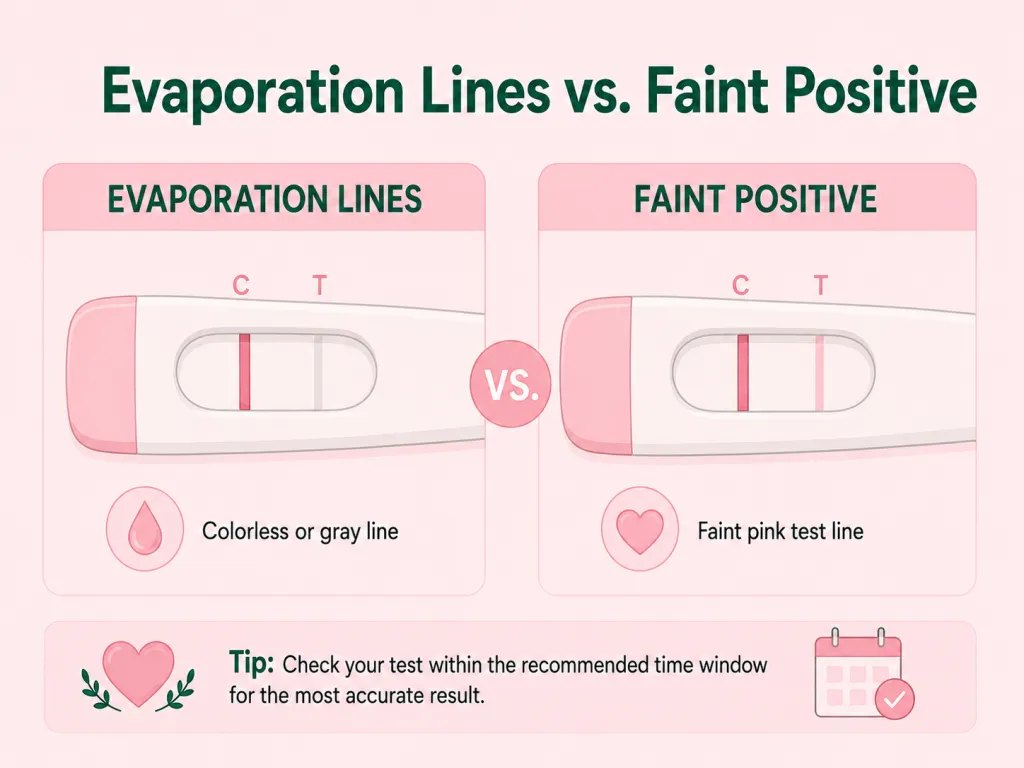
Beyond color and timing, the physical appearance of the line itself can offer useful clues. A faint positive line is typically solid, uniform, and clearly formed. It runs across the result window in the same position and width as the control line, even if it’s lighter.
An evaporation line often looks different. It may appear thin, streaky, uneven, or incomplete. Some evap lines show up as a partial mark that doesn’t extend fully across the window. Others look smudged or blurred rather than clean and defined. If the line in question doesn’t match the consistency of the control line, that’s a strong signal that it may not be a true result.
Meaning
The most important difference between these two lines is what they actually mean for your result. A faint positive, no matter how light it appears, indicates that hCG has been detected in your urine and pregnancy is likely. The hormone is present, the test has reacted to it, and a follow-up test in 24 to 48 hours typically shows a darker line as hCG levels continue to rise.
An evaporation line, by contrast, carries no diagnostic meaning. It is not a positive, not a negative trending toward positive, and not an early sign of anything. The test simply produced an artifact as the sample dried, and the underlying result is negative. If a faint mark only appeared after the reading window closed, the appropriate next step is to disregard that test and take a fresh one, reading the result within the proper time frame.
Tips for Retesting Your Pregnancy Test
If you’re unsure whether what you’re seeing is a faint positive or an evaporation line, retesting is the most straightforward next step. Waiting 24 to 48 hours before taking another test gives hCG levels time to rise if pregnancy is present, which often produces a clearer, more definitive result.
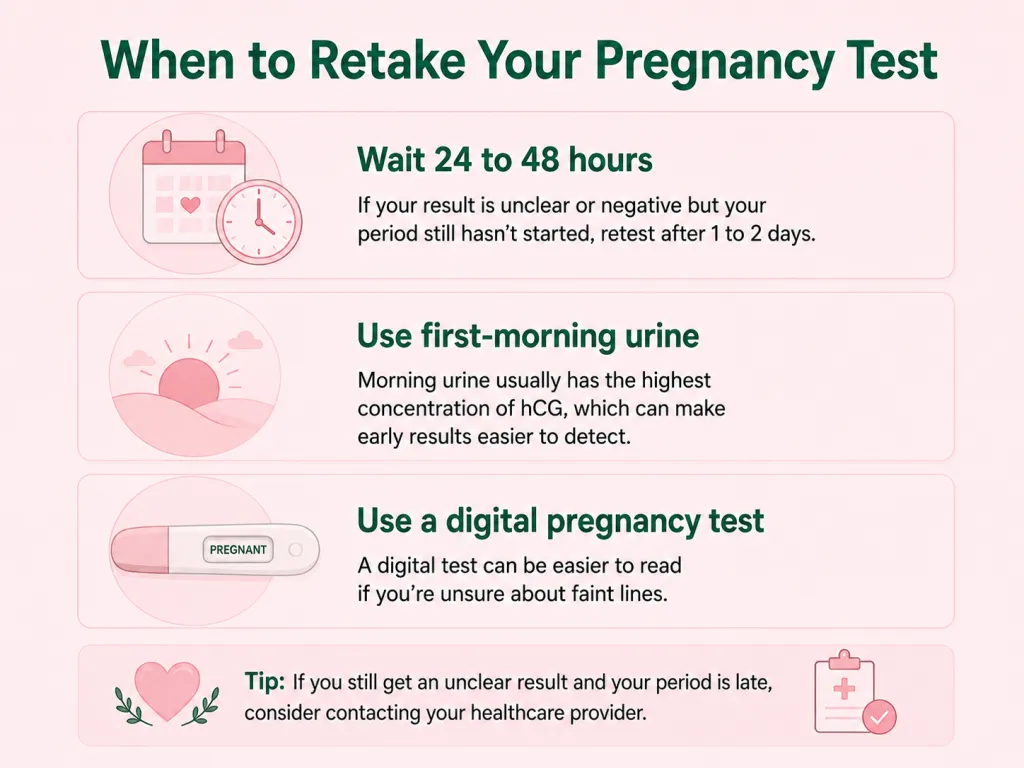
For the most accurate retest, use first-morning urine. This is your most concentrated sample of the day and contains the highest levels of hCG, making it easier for the test to detect. Avoid drinking excessive fluids before testing, as diluted urine can result in lighter lines.
A digital pregnancy test is another strong option when clarity is the goal. Digital tests display a straightforward “Pregnant” or “Not Pregnant” reading, which eliminates the ambiguity of interpreting line color and intensity altogether. A study published in Clinical Chemistry found that home pregnancy test devices varied widely in their hCG detection limits, ranging from 6.3 to 50 IU/L, and that 60% of the 15 devices evaluated had poorer sensitivity for certain hCG variants common in early pregnancy. These findings reinforce the importance of choosing a test with high sensitivity and following the manufacturer’s instructions carefully to minimize the chance of a misleading result.
When to Contact a Healthcare Provider
In some situations, a conversation with a healthcare provider is the best path forward. If you’ve taken multiple tests and keep getting faint or inconsistent results, a provider can order a blood hCG test, which is significantly more sensitive than a home urine test and can detect pregnancy earlier with greater accuracy.
Research comparing urine and serum pregnancy testing in clinical settings found that serum tests achieved an overall efficiency of 99.5%, compared to 97.6% for urine tests. The difference was most pronounced in cases involving ectopic pregnancies, where the serum test identified 100% of cases while the urine test detected only 60%.
It’s also worth reaching out if you’re experiencing symptoms like unusual cramping, spotting, or pelvic pain alongside an unclear test result. These symptoms may warrant further evaluation regardless of what the test shows. Similarly, if you have a history of conditions such as ectopic pregnancy or chemical pregnancy, professional guidance can help ensure nothing is overlooked.
Consulting a provider doesn’t mean something is wrong. It simply means you’re taking a proactive step toward getting a clear answer. Lab-based testing provides the most reliable confirmation, and a healthcare professional can help interpret results within the context of your individual health.
Reading Your Result With Confidence
The difference between a faint positive and an evaporation line comes down to three things: timing, color, and appearance. A colored line that appears within the recommended reading window is generally a valid positive result, even if it’s light. A colorless mark that shows up after the test has dried is far more likely to be an evaporation line and should not be read as a positive.
If there’s any doubt, give it a day or two and test again with first-morning urine or a digital test. Follow the instructions on the box, read your result within the specified window, and trust what you see during that time. These small steps go a long way toward getting the clear, reliable answer you deserve.
Frequently Asked Questions
How many minutes does the evaporation line appear?
Evaporation lines typically appear 10 or more minutes after taking the test, once the urine on the strip has begun to dry past the recommended reading window.
Can a pregnancy test turn positive after 20 minutes?
A line appearing after 20 minutes is most likely an evaporation line, not a true positive. Pregnancy test results should only be read within the time frame specified in the instructions, which is usually 3 to 5 minutes.
How faint does a line have to be to be positive?
Any line with visible color, no matter how faint, is generally considered a positive result as long as it appears within the test’s reading window. The darkness of the line does not determine whether the result is valid.