Is Spinal Fusion Right for You? Key Questions Every Patient Should Ask
<p>Facing the possibility of spinal fusion surgery can feel overwhelming. This major procedure, which permanently joins two or more vertebrae to eliminate motion at specific spinal segments…
- Published
- Written by
- Women In Balance Team
- Reading time
- 4 minutes
Facing the possibility of spinal fusion surgery can feel overwhelming. This major procedure, which permanently joins two or more vertebrae to eliminate motion at specific spinal segments, represents a significant decision that will impact your life for years to come. Understanding what to ask your surgeon and knowing all available treatment options, including spinal fusion alternatives, is crucial for making an informed choice about your spinal health.
Spinal fusion is often recommended for conditions such as degenerative disc disease, spondylolisthesis, spinal stenosis with instability, and certain types of spinal deformities. While the procedure has helped countless patients find relief from chronic pain and improved stability, it’s not the right solution for everyone. The key is asking the right questions to determine whether fusion aligns with your specific condition, lifestyle, and long-term health goals.
Essential Questions to Ask Your Surgeon
What is my exact diagnosis, and why is fusion recommended for my condition?
Understanding your specific spinal problem is fundamental to evaluating treatment options. Ask your surgeon to explain your diagnosis in detail, including which spinal levels are affected and how your symptoms relate to the underlying structural problems. Request to see your imaging studies (X-rays, MRI, or CT scans) and have the surgeon point out the problematic areas. Different conditions may have alternative treatments that could be equally effective with less invasive approaches.
Have all conservative treatments been exhausted?
Spinal fusion is typically considered only after non-surgical treatments have failed to provide adequate relief. Ensure you’ve tried appropriate conservative measures, including physical therapy, medications, injections, and lifestyle modifications. Ask about the expected timeline for conservative treatment and what specific improvements (or lack thereof) would indicate that surgery is necessary.
What are the specific risks and potential complications of my proposed fusion procedure?
Every surgical procedure carries risks, and spinal fusion is no exception. Potential complications include infection, nerve damage, hardware failure, pseudarthrosis (failure of the bones to fuse), and adjacent segment disease (accelerated degeneration of spinal levels above and below the fusion). Ask about your personal risk factors and how your age, overall health, and lifestyle might affect your surgical outcome.
What is the expected recovery timeline, and what limitations will I face?
Recovery from spinal fusion typically takes several months, with some patients requiring up to a year to fully heal. Understand what your recovery will look like week by week, including when you can return to work, drive, exercise, and perform daily activities. Ask about any permanent limitations you might face and how these could impact your lifestyle and recreational activities.
How will fusion affect the rest of my spine?
One of the most important long-term considerations is adjacent segment disease – the accelerated wear and tear that can occur at spinal levels above and below a fusion. Studies suggest that 25-40% of patients may develop problems at adjacent levels within 10-20 years after fusion surgery. Discuss this risk and what it might mean for your future spinal health.
What are my alternatives to fusion?
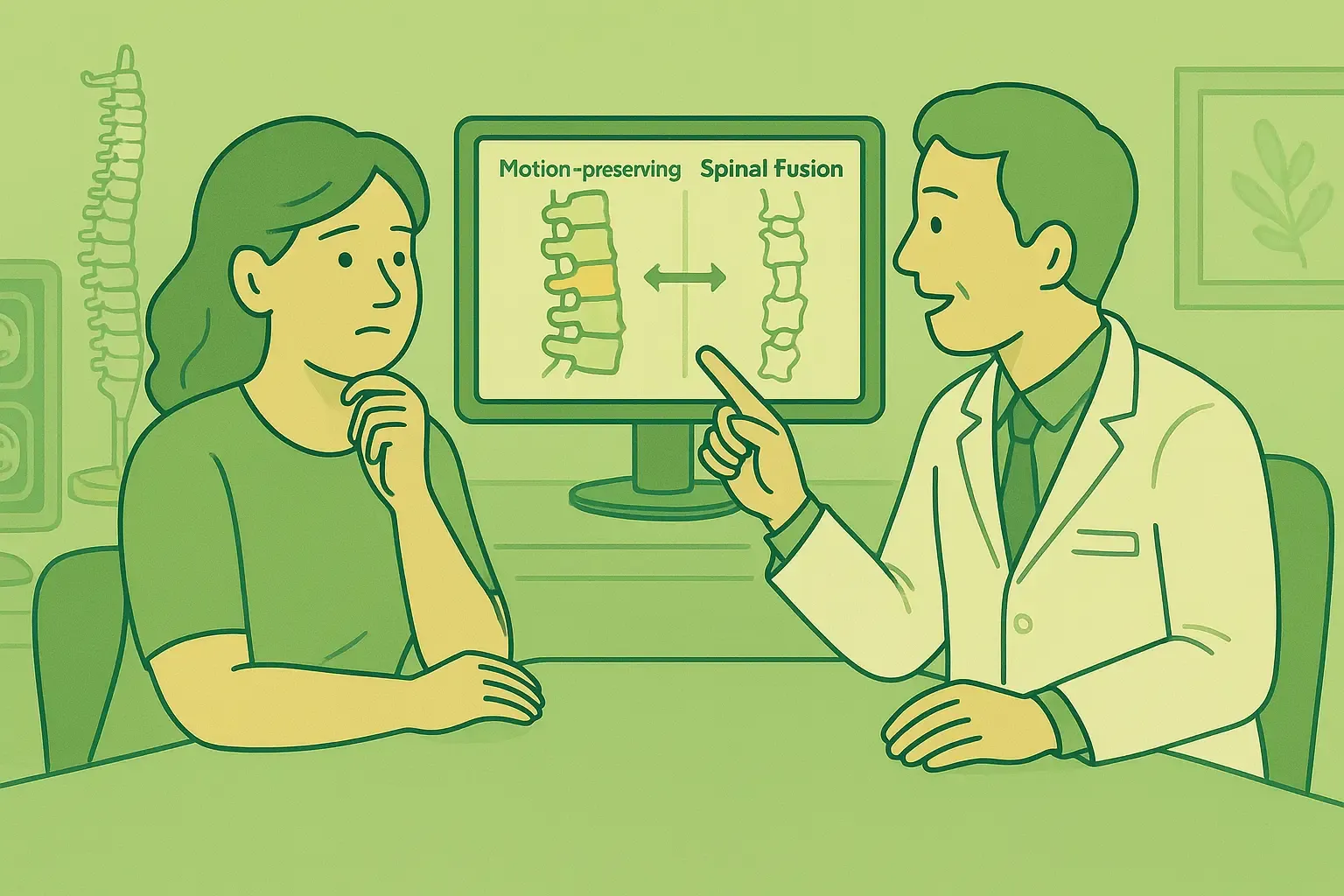
This is perhaps the most crucial question to ask. Many patients are unaware that alternatives to fusion exist, particularly for conditions involving spinal instability. Motion-preserving technologies and less invasive procedures may provide similar benefits while maintaining spinal flexibility.
What are the long-term success rates for my specific condition?
Ask for specific statistics about success rates for patients with your exact diagnosis, age, and activity level. Understand how “success” is defined – is it based on pain reduction, functional improvement, or patient satisfaction? Request information about both short-term and long-term outcomes.
How many of these procedures has the surgeon performed?
Experience matters significantly in spinal surgery. Ask about your surgeon’s experience with your specific procedure, their complication rates, and their patient outcomes. Don’t hesitate to seek a second opinion, especially if you have concerns about the recommended treatment plan.
Motion-Preserving Alternatives: Mechanical Spinal Devices
While considering spinal fusion, it’s essential to understand that innovative alternatives exist that can address spinal instability while preserving natural movement. Mechanical spinal devices, particularly the Premia TOPS (Total Posterior Spine) System, represent a significant advancement in treating conditions that traditionally required fusion.
How These Systems Compare to Fusion
Devices like the Premia TOPS System offer several distinct advantages over traditional spinal fusion. Unlike fusion, which permanently eliminates motion at the treated spinal segment, the TOPS device allows controlled movement in all directions – flexion, extension, lateral bending, and axial rotation. This preservation of natural biomechanics can significantly impact long-term spinal health.
The device consists of titanium plates connected by a sophisticated mechanical joint that maintains stability while allowing physiological motion. This design helps prevent the adjacent segment disease commonly associated with fusion procedures, as the preserved motion reduces stress on neighboring spinal levels.
Clinical Benefits and Outcomes
Patients treated with the TOPS System typically experience faster recovery times compared to fusion surgery. Because the natural movement is preserved, there’s less disruption to the spine’s biomechanics, potentially leading to better long-term outcomes. Clinical studies have shown that TOPS patients maintain their ability to bend, twist, and move naturally while achieving significant pain reduction and improved function.
The procedure for TOPS implantation is similar to fusion in terms of decompressing neural elements, but the preservation of motion means patients often return to normal activities more quickly. Many patients report feeling more “normal” after TOPS surgery because their spine continues to move naturally.
Thanks for reading. We hope this article has answered any questions you may have had about spinal fusion and eased any doubts.