Mucus Plug vs Discharge: How to Tell the Difference in Late Pregnancy
Key Takeaways You’ve reached the late stretches of pregnancy, and one morning you notice something on the toilet paper or your underwear that’s thicker than your usual discharge. Your first thought…
- Published
- Written by
- Women In Balance Team
- Reading time
- 8 minutes

Key Takeaways
- The mucus plug is a thick, gel-like clump of cervical mucus that seals the cervix during pregnancy. It looks distinctly different from normal pregnancy discharge — thicker, more substantial, often jelly-like or rope-like, and may be tinged pink, brown, or red.
- Normal late-pregnancy discharge (leukorrhea) is thin and milky white, appears in panty-liner amounts daily, and is consistent with what you’ve experienced throughout pregnancy. The mucus plug is a discrete event — usually a single clump or a few clumps over a day or two.
- Losing the mucus plug does not reliably predict when labor will start. It can come out hours, days, or even weeks before active labor. If you have heavy bleeding, contractions, or your water breaks, contact your healthcare provider immediately.
You’ve reached the late stretches of pregnancy, and one morning you notice something on the toilet paper or your underwear that’s thicker than your usual discharge. Your first thought: Is this the mucus plug? Is labor about to start?
Mucus plug and discharge can look similar at a glance, but they typically have distinct differences in texture, volume, color, and timing. The honest reassurance up front: losing the mucus plug doesn’t always mean labor is right around the corner — it can come out hours, days, or even weeks before active labor begins. This article walks through what each one is, what each one looks like, how to tell them apart, what bloody show means, and when it’s time to call your doctor.
What Is the Mucus Plug?
The mucus plug is a thick, gel-like collection of cervical mucus that forms early in pregnancy and seals the cervix to protect the developing baby from infection. Some people call it the cervical mucus plug or simply “the plug.”
It forms because of rising progesterone in early pregnancy, which stimulates the cervix to produce thick, dense mucus that builds up into a sealed plug filling the cervical canal. By the third trimester, it’s typically about 4–5 cm long and contains roughly 30–40 mL of mucus. Per a comprehensive review of the cervicovaginal mucus barrier published in PMC, this plug acts as the first line of defense against bacteria ascending from the vagina toward the uterus — a function critical for protecting the fetus throughout pregnancy.
The plug stays in place for almost the entire pregnancy. It only releases when the cervix begins to soften, thin, and dilate in preparation for labor — which is why losing it is sometimes (but not always) a sign that labor is approaching.
Here’s what the mucus plug typically looks like: thick, gel-like, and substantial — like a clump of jelly or a thick blob of nasal mucus. Most women describe it as:
- Texture: thick, gel-like, jelly-like, sometimes stringy or rope-like — similar to a chunk of egg white but firmer.
- Volume: typically tablespoon-sized or walnut-sized — a discrete clump, not a continuous flow.
- Color: clear, white, off-white, or pale yellow. Sometimes pink-tinged, brown-streaked, or with small amounts of red blood mixed in (this is “bloody show,” covered below).
- Pattern: comes out as one substantial piece, or in several smaller clumps over a few days.
It’s a distinct event. If you see it, you’ll generally know something different has happened — the consistency and volume are noticeably unlike anything you’d see in normal discharge.
What Is Late-Pregnancy Discharge?
Late-pregnancy discharge — medically called leukorrhea — is the normal vaginal discharge that increases throughout pregnancy due to rising estrogen and increased blood flow to the cervix and vaginal walls. It’s not a labor sign on its own. It’s the body’s everyday protective system, working a bit harder than usual.
The mechanism is straightforward. Estrogen and progesterone stimulate the cervix and vaginal walls to produce more mucus throughout pregnancy. Volume increases gradually, often becoming heaviest in the third trimester. This discharge maintains the vaginal pH, supports a healthy bacterial balance, and is part of how the body protects itself — and the baby — from infection.
Here’s what normal late-pregnancy discharge typically looks like: thin, milky white or clear, mild in odor, and continuous throughout the day. Specifically:
- Texture: thin to mildly creamy — more watery than gel-like.
- Color: milky white or clear. May dry slightly yellow on underwear.
- Volume: smaller per occurrence — panty-liner amounts, steady throughout the day.
- Pattern: continuous, not a discrete event. You’d notice it daily, not as a single moment.
If you’ve been tracking changes throughout pregnancy, this discharge has likely been increasing gradually since the first trimester. The full picture of how it shifts across pregnancy is covered in the article on early pregnancy discharge, which walks through what’s normal at each stage.
Mucus Plug vs Discharge
The mucus plug is thick, gel-like, comes out as a discrete clump, and signals late-pregnancy cervical changes. Normal discharge is thin, milky, comes out continuously, and is part of the body’s daily protective function. The differences come down to five things: texture, color, volume, pattern, and timing.
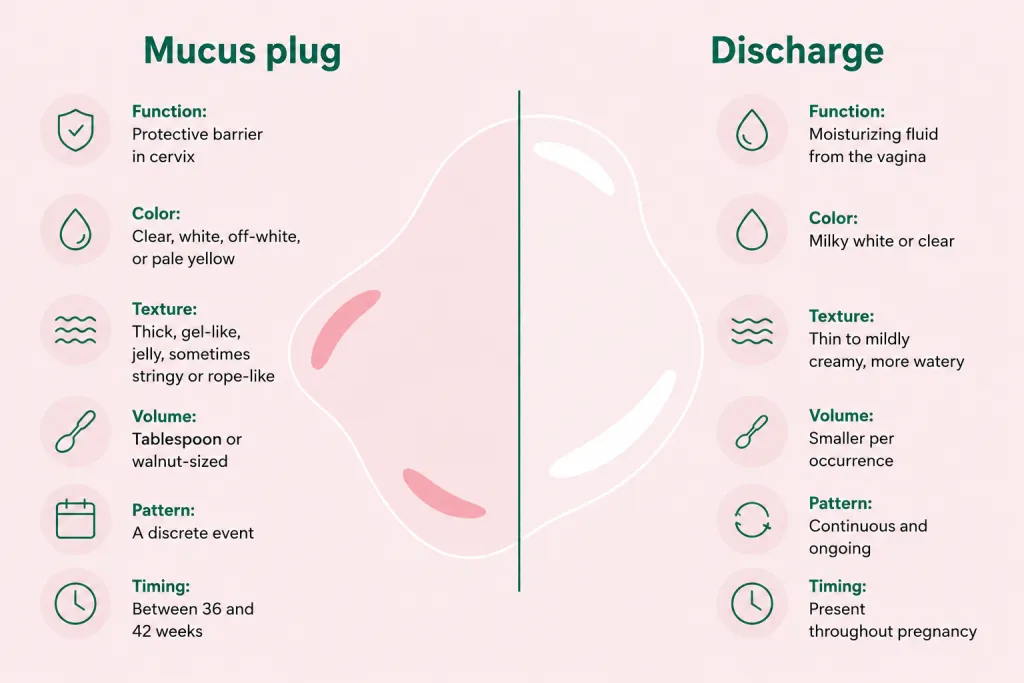
Texture
Mucus plug: thick, gel-like, jelly, sometimes stringy or rope-like. Resembles a thick blob of nasal mucus or a chunk of egg white. You can pick it up — it holds its shape.
Discharge: thin to mildly creamy, more watery. Doesn’t hold its shape. Spreads on a panty liner rather than sitting as a clump.
Color
Mucus plug: typically clear, white, off-white, or pale yellow. Sometimes pink-tinged, brown-streaked, or with small amounts of red blood.
Discharge: milky white or clear. May dry slightly yellow on underwear. Bright red or heavily blood-tinged is not typical for either — that warrants a doctor visit.
Volume
Mucus plug: tablespoon-sized or walnut-sized. A noticeable clump.
Discharge: smaller per occurrence — panty-liner amounts, distributed throughout the day rather than appearing all at once.
Pattern
Mucus plug: a discrete event. Comes out as one piece, or as a few smaller clumps over a day or two, then stops.
Discharge: continuous and ongoing. You’d notice it daily, not as a single moment.
Timing
Mucus plug: typically released between 36 and 42 weeks, as the cervix softens and prepares for labor. Can occur earlier in some cases.
Discharge: present throughout pregnancy, with volume usually increasing gradually toward the third trimester.
In practice, women who’ve never seen the mucus plug before sometimes mistake it for a particularly thick episode of discharge. The two distinguishing features are the consistency (gel vs creamy) and the discrete-event nature (single clump vs daily continuous).
What Is Bloody Show?
Bloody show is the mucus plug with small amounts of blood mixed in — pink, brown, or red-tinged. The blood comes from small vessels at the cervix breaking as it begins to dilate and efface in preparation for labor.
It’s worth distinguishing carefully from concerning bleeding. Bloody show is small amounts of blood mixed into mucus — not frank red bleeding. Heavy bright red bleeding warrants immediate medical attention, and is not a normal labor sign.
Bloody show is generally a closer-to-labor sign than a clear or white mucus plug, but it still doesn’t reliably predict exact timing. Some women experience bloody show hours before labor starts; others have it days in advance.
Losing the Mucus Plug: When and What Comes Next
Most women lose the mucus plug between 37 and 42 weeks, but it can happen earlier. Some lose it weeks before labor; others not until labor is actively underway. Losing the mucus plug does not reliably predict when labor will start. Labor can follow within hours, days, or even weeks.
Worth knowing: the body can sometimes regenerate part of the mucus plug. Losing it once doesn’t mean it’s permanently gone — and even if it doesn’t regenerate, the cervix has other protective mechanisms. So losing it isn’t a reason to rush to the hospital on its own.
The more reliable signs that labor is actually beginning are:
- Regular contractions that get closer together and stronger over time
- Water breaking — clear or pale yellow fluid, sometimes a gush, sometimes a steady leak
- Low back pain that doesn’t ease with rest or position changes
- Bloody show getting heavier or more frequent — especially when paired with contractions
If you’re tracking how far along you are or want to estimate your expected labor window, the pregnancy calculator can help anchor where you are in the timeline.
For the official ACOG signs of labor onset, their page on how to tell when labor begins walks through what to watch for and when to head to the hospital.
When to Call Your Doctor
Most mucus plug loss is normal and doesn’t require an immediate call. But contact a healthcare provider if any of these apply:
- Heavy bright red bleeding — more than spotting or pink-tinged mucus.
- Loss of mucus plug before 37 weeks — this can be a sign of preterm labor.
- Regular contractions that increase in intensity and frequency.
- Water breaking — clear or pale yellow gushing fluid.
- Severe abdominal or pelvic pain.
- Decreased fetal movement — fewer kicks or movements than your usual baseline.
- Fever, chills, or unusual discharge with strong odor.
Calling your provider for any uncertainty is always appropriate. Late-pregnancy questions are part of why providers are available 24/7. If you’re managing a high-risk pregnancy, trust your instinct even more — there’s no such thing as calling too early.
Conclusion
The mucus plug is thick, gel-like, and a discrete event. Normal late-pregnancy discharge is thin, creamy, and continuous. Telling them apart usually comes down to texture (gel vs creamy) and pattern (one clump vs daily flow).
Losing the mucus plug is one of many late-pregnancy signs, but it doesn’t reliably tell you when labor will start. Trust your provider’s guidance for what to watch for, and call them for any uncertainty. If you’re preparing for what comes after delivery, postpartum home safety considerations are worth thinking through now while you have time.
Frequently Asked Questions
How long after losing the mucus plug does labor start?
Labor can begin within hours, days, or even weeks after the mucus plug is released. There’s no reliable way to predict exact timing from mucus plug loss alone — contractions, water breaking, and bloody show are stronger labor signals.
Can you lose your mucus plug weeks before labor?
Yes. Some women lose their mucus plug several weeks before active labor begins. The body can also regenerate part of the plug, so losing it once doesn’t mean it’s permanently gone or that labor is imminent.
What’s the difference between mucus plug and bloody show?
Bloody show is the mucus plug with small amounts of blood mixed in — pink, brown, or red-tinged — caused by small blood vessels breaking as the cervix dilates. A clear or white mucus plug without blood is typically released earlier; bloody show usually appears closer to active labor.