10 Signs Your Period Is Coming Tomorrow: What to Expect in the Final 24 Hours
Key Takeaways If you’re tracking signs your period is coming tomorrow, you’re likely in the final 1 to 2 days of your luteal phase and watching your body for the cues that confirm what your cycle is…
- Published
- Written by
- Women In Balance Team
- Reading time
- 6 minutes
Key Takeaways
- Signs your period is coming tomorrow include intensified cramping, peak breast tenderness, mood shifts, fatigue, and often a small amount of pink or brown spotting in the final 24 hours.
- These late-luteal symptoms are driven by the sharp drop in progesterone in the 24 to 48 hours before menstruation begins.
- Cycle tracking is the most reliable way to predict your period — symptoms alone can give a strong signal, but pattern recognition over 2 to 3 cycles makes timing predictable.
If you’re tracking signs your period is coming tomorrow, you’re likely in the final 1 to 2 days of your luteal phase and watching your body for the cues that confirm what your cycle is already telling you. The 10 signs in this article focus on what specifically happens in the final 24 to 48 hours before your period starts — different from the broader PMS that builds across the previous 1 to 2 weeks.
The mechanism driving these signs is a sharp progesterone drop. As progesterone falls, prostaglandin levels rise, the uterine lining begins breaking down, and your body produces a recognizable cluster of late-luteal symptoms. This article walks through the 10 most reliable signs, how to combine them with cycle tracking, and how to distinguish tomorrow-signs from broader PMS or early pregnancy.
10 Signs Your Period Is Coming Tomorrow
These 10 signs typically appear or intensify in the final 24 to 48 hours before your period begins. They’re the subset of PMS that peaks right at the end — telling your body the cycle is about to reset.
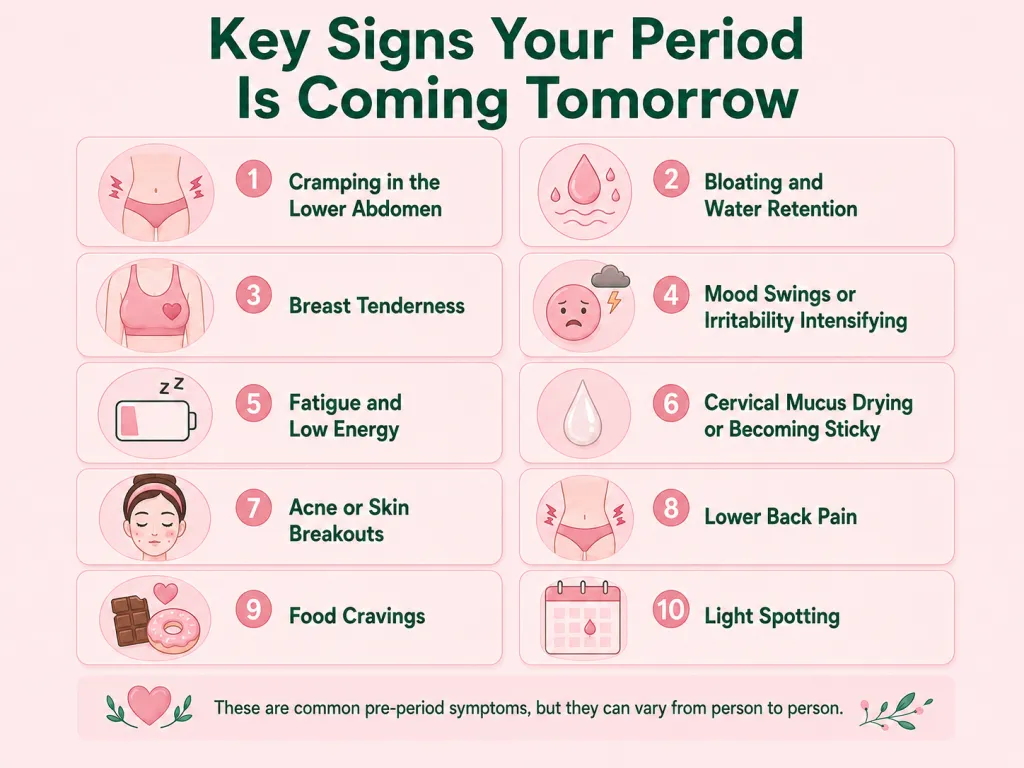
1. Cramping That Starts in the Lower Abdomen
What it feels like: mild to moderate dull cramping, central in the lower abdomen, often described as “a deep ache” or “a feeling of pressure.”
Why: as progesterone drops, prostaglandin levels rise, triggering the uterine contractions that will progress into period cramps.
Distinguishing feature: tomorrow-cramps are typically mild and central. Sharp or one-sided pain warrants medical attention — the article on period cramps vs early pregnancy cramps walks through how cramping patterns differ.
2. Peak Bloating and Water Retention
What it feels like: tight pants in the evening, finger or face puffiness, fluid retention in the lower belly.
Why: estrogen and progesterone shifts affect sodium and water balance throughout the luteal phase.
Timing: bloating builds across the luteal phase but peaks in the final 1 to 2 days, easing once flow starts.
3. Breast Tenderness Peaking
What it feels like: sensitivity to bra straps, soreness when sleeping on your chest, fullness peaking just before period.
Why: hormonal changes affecting breast tissue throughout the luteal phase, with sensitivity peaking right before the progesterone drop.
Distinguishing feature: pregnancy-related breast tenderness usually persists and intensifies. PMS-related tenderness eases once the period starts.
4. Mood Swings or Irritability Intensifying
What it feels like: feeling more sensitive, tearful, or irritable than usual; low frustration tolerance; emotional volatility.
Why: progesterone and estrogen affect neurotransmitter levels (serotonin, GABA). The sharp progesterone drop right before the period intensifies mood effects.
More on this: if you find that hormonal shifts consistently affect your mental health, hormonal imbalance and anxiety covers the connection in depth.
5. Fatigue and Low Energy
What it feels like: feeling more tired than usual, needing more sleep, low motivation that doesn’t lift with caffeine.
Why: hormonal fluctuations affecting sleep quality and energy regulation in the final luteal-phase days.
Note: this is one of the most universal pre-period signs.
6. Cervical Mucus Drying or Becoming Sticky
What it feels like: discharge becomes minimal, sticky, or absent in the 1 to 2 days before period; underwear feels noticeably drier.
Why: estrogen and progesterone both decline in the late luteal phase, reducing cervical fluid production. The article on luteal phase discharge covers the full luteal-phase discharge pattern.
Distinguishing feature: stark contrast from the wet, slippery mucus of ovulation.
7. Acne or Skin Breakouts
What it feels like: new blemishes, especially along the jawline, chin, or back, appearing 1 to 2 days before period.
Why: hormonal fluctuations (particularly androgens relative to estrogen) drive late-luteal acne.
Timing: typically appears 1 to 3 days before period starts and resolves once flow begins.
8. Lower Back Pain
What it feels like: dull, low-back ache concentrated in the sacral area; often paired with lower abdominal cramping.
Why: uterine contractions and inflammation referring pain to the lower back via shared nerve pathways.
Distinguishing feature: usually mild and bilateral. Severe one-sided back pain warrants medical evaluation.
9. Food Cravings
What it feels like: strong cravings for salty, sweet, or carb-heavy foods in the final 1 to 2 days before period.
Why: hormonal fluctuations affect blood sugar regulation, serotonin levels, and appetite hormones.
Common cravings: chocolate, salty snacks, refined carbohydrates.
10. Light Spotting
What it feels like: a few drops of pink or brown blood on underwear or when wiping in the final hours before period starts.
Why: the very early breakdown of the uterine lining as progesterone drops.
Distinguishing feature: tomorrow-spotting is light and brief. If spotting persists outside the period window, the article on spotting vs period covers when it warrants further attention.
Tomorrow-Signs vs Broader PMS: What’s the Difference?
PMS symptoms typically build across the 1 to 2 weeks before a period — the entire luteal phase. The signs in this article specifically intensify in the final 24 to 48 hours as progesterone drops sharply.
If you’re noticing PMS-like symptoms but they don’t intensify in this final window, your period may be more than 24 hours away. If your period doesn’t arrive within 24 to 48 hours of these peak signs, signs of a period coming late covers what to watch for when a period is delayed past expected start.
How to Combine Symptoms With Cycle Tracking
The most reliable prediction combines symptom recognition with cycle tracking. Symptoms alone can give a strong signal, but pattern recognition over 2 to 3 cycles makes timing genuinely predictable.
Use a cycle-tracking app or the Women in Balance period calculator to log your cycle start date, cycle length, and symptom intensity day by day. After 2 to 3 cycles, patterns emerge: your specific symptom signature in the final 24 to 48 hours becomes recognizable. Premium fertility and cycle monitoring tools can add hormone-level tracking for deeper pattern insight if you want to go beyond app-based logging. For broader medical context on the menstrual cycle and what affects timing, a reputable medical authority is a useful additional reference.
The reliable predictors are your average cycle length plus your personal symptom signature. Less reliable: any single symptom in isolation.
Knowing Your Body’s Pattern
The 10 signs above — cramping, bloating, breast tenderness, mood shifts, fatigue, dry cervical mucus, acne, back pain, cravings, and light spotting — typically intensify in the final 24 to 48 hours before a period starts. None of them is a 100% guarantee on its own, but together, paired with cycle tracking, they let you predict your period with surprising accuracy.
Track your cycles for 3 months, note your personal symptom signature, and the timing becomes far less mysterious. Once you know what your body does in those final hours, you can prepare for the first day with confidence.
Frequently Asked Questions
How can I tell if my period is coming tomorrow?
The most reliable combination is cycle tracking plus symptom recognition. Late-luteal signs like intensified cramping, peak breast tenderness, mood shifts, fatigue, and light pink or brown spotting typically appear in the final 24 to 48 hours before a period. No single sign is a 100% guarantee.
What happens the night before you get your period?
Progesterone drops sharply in the 24 to 48 hours before menstruation. This triggers a cluster of late-luteal symptoms: cramping intensifies, bloating peaks, breast tenderness reaches its strongest, and some women notice light spotting. The drying of cervical mucus and a dip in energy are also common.
Are pre-period symptoms the same as early pregnancy symptoms?
They overlap heavily because both involve elevated progesterone earlier in the cycle. The distinguishing pattern: PMS symptoms ease once a period starts, while pregnancy-related symptoms persist or intensify past the expected period date. A pregnancy test taken on or after your expected period date is the most reliable way to tell them apart.