8 Signs of Period Coming Late: Symptoms and What They Mean
Key Takeaways You’ve been tracking your cycle. The day your period was supposed to arrive came and went. You’re feeling cramps, bloating, maybe breast tenderness — but the period itself hasn’t…
- Published
- Written by
- Women In Balance Team
- Reading time
- 9 minutes
Key Takeaways
- Signs that your period is coming late often look identical to PMS — cramping, bloating, breast tenderness, mood changes, fatigue — but they appear past your expected start date instead of just before it. Some signs (like spotting without a full period) are more specific to a delayed cycle.
- Late-period symptoms can also overlap with early pregnancy. The two are nearly impossible to tell apart by symptoms alone — a pregnancy test taken on or after the day your period was due is the only reliable way to know.
- A period is generally considered late after 5 or more days past your expected start date. If you’ve gone 7+ days without a period, it’s worth taking a pregnancy test. If you have persistently irregular cycles, talk to a healthcare provider.
You’ve been tracking your cycle. The day your period was supposed to arrive came and went. You’re feeling cramps, bloating, maybe breast tenderness — but the period itself hasn’t started. What’s going on?
Signs of period coming late often mirror PMS — your body is producing the same hormonal signals it would before any normal period — but they’re showing up past your expected start date instead of before it. Most of the time these symptoms mean the period is just running a few days behind, but they can also overlap with early pregnancy, which is why a pregnancy test is the only reliable way to know.
Below are the 8 most common signs to watch for, what each one tends to feel like, and when it’s time to test or call your provider. For the deeper question of why your period might be running late — pregnancy, stress, hormonal shifts, contraception, weight changes, or other causes — the article on reasons your period might be late covers the full causes-side picture.
8 Signs of Period Coming Late
A period is generally considered late after 5 or more days past your expected start date, and missed after 7+ days. A normal cycle ranges from 21 to 35 days, with most around 28 days, and natural cycle variation of up to 7 to 9 days month to month is common in healthy women.
Most of these signs are familiar from PMS — your body is producing the same hormonal signals as it would before any period — but they’re appearing past your expected start. Here are the 8 most common, in roughly the order most women notice them.
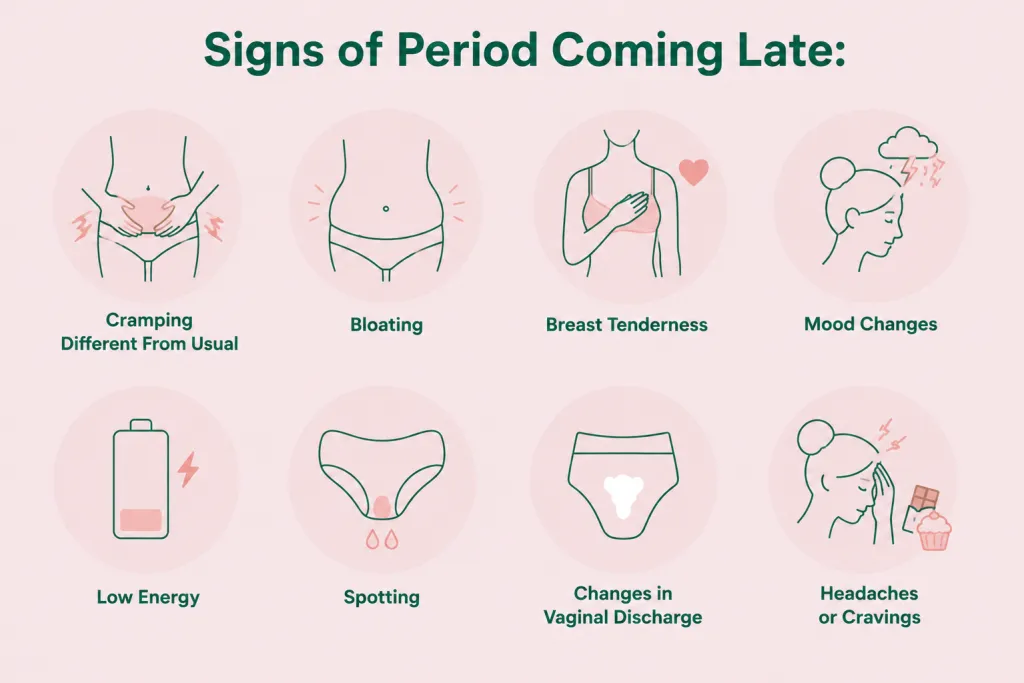
1. Cramping That Feels Different From Usual
Late-period cramps are typically mild, dull, and centrally located in the lower abdomen — similar in feel to PMS cramps, but lingering past your expected period start without progressing into a flow. Many women describe them as coming and going in waves rather than staying steady.
It’s worth noting that not all cramps mean the same thing. Sharper, one-sided cramps can signal something else and warrant a doctor visit. Milder, central twinges can sometimes signal early pregnancy rather than an impending period — the article on period cramps vs early pregnancy cramps walks through how the two compare in detail.
2. Bloating and Water Retention

Bloating shows up as the recognizable “tight pants in the evening” feeling — fluid retention in the lower belly, sometimes paired with finger or face puffiness. It’s caused by elevated progesterone, which slows digestive transit and triggers water retention.
Bloating typically peaks just before a period would normally start. Persistent bloating into a delayed period can feel uncomfortable and is one of the most universally reported late-period signs. Worth knowing: bloating is also a very common early pregnancy symptom, so on its own it doesn’t tell you which one you’re dealing with.
3. Breast Tenderness or Sensitivity
Most women describe late-period breast tenderness as sensitivity to bra straps, soreness when sleeping on the chest, or a general fullness or heaviness. It’s caused by elevated progesterone (and in pregnancy, hCG) acting on breast tissue.
Late-period breast tenderness usually feels similar to typical PMS soreness — but it can also be among the earliest signs of pregnancy. Duration is sometimes a clue: PMS breast tenderness usually eases once a period starts, while pregnancy-related tenderness tends to persist and intensify.
4. Mood Changes and Irritability
Feeling more sensitive, tearful, or irritable than usual — or noticing emotional volatility and low frustration tolerance — can all signal a late period. The cause is hormonal: late luteal phase fluctuations in progesterone and estrogen affect neurotransmitter levels.
Some women also experience anxiety specifically tied to a late cycle, which compounds the mood symptoms. If you find that hormonal cycles consistently affect your mental health, hormonal imbalance and anxiety explores the connection in more depth.
5. Fatigue and Low Energy

Persistent fatigue past your expected period start — feeling more tired than usual, needing more sleep, low motivation — is one of the most common late-period signs. Elevated progesterone has a sedating effect, and it stays elevated until either a period starts (after which it drops) or pregnancy continues to maintain it.
Fatigue is also one of the very earliest pregnancy symptoms, often noticed within the first 1 to 2 weeks after conception. The two can feel nearly identical, which is part of why symptoms alone can’t confirm what’s happening.
6. Spotting Without a Full Period
This sign is more specific to a delayed cycle than typical PMS. Light brown or pink spotting that doesn’t progress to a full flow can mean a few things: a late-arriving period that’s just beginning, hormonal fluctuation, or implantation bleeding if you’re pregnant.
How to tell them apart: implantation bleeding is typically very light, lasts 1 to 3 days, and tends to be pink or brown rather than red. A late period that’s finally starting will usually progress to normal flow within a day or two. The article on what implantation cramps feel like covers the full implantation timing and sensation pattern if you suspect that’s what you’re seeing.
7. Changes in Vaginal Discharge
Discharge texture and volume in a delayed cycle often differs from your usual luteal-phase pattern. Late-period discharge tends to be dry, sticky, or slightly creamy — typical luteal phase discharge persisting past expected period start.
Increased thin, milky white discharge in this window can sometimes signal pregnancy. The article on early pregnancy discharge walks through the texture, color, and volume changes that point toward pregnancy specifically. For the broader comparison angle, discharge before period vs early pregnancy breaks down the differences cycle by cycle.
8. Headaches or Food Cravings

Tension headaches and cravings for salty, sweet, or carb-heavy foods are common late-period signs. The cause is hormonal fluctuation affecting blood sugar, water balance, and neurotransmitter levels.
These symptoms are most common in women who already get PMS-related headaches or cravings — the same pattern can show up in a delayed cycle, sometimes with slightly more intensity than usual. They’re rarely the first sign noticed but often appear alongside the others on this list.
Late Period vs Early Pregnancy: Why Symptoms Can Look Identical
In real time, late-period symptoms and early pregnancy symptoms can look strikingly similar. Most women only know which it was after they take a pregnancy test or see whether their period eventually arrives.
The reason for the overlap: PMS and early pregnancy both involve elevated progesterone, the hormone driving cramping, breast tenderness, fatigue, mood changes, and bloating. In a normal cycle without pregnancy, progesterone drops and a period starts. In pregnancy, progesterone stays elevated to support the developing pregnancy, and the same symptoms continue or intensify.
A few patterns that can hint (but not confirm):
- Cramping: PMS cramps often build up before a period and ease once flow starts. Early pregnancy cramps tend to be milder, more central, and may persist past when a period was due.
- Breast tenderness: PMS tenderness usually fades when a period arrives. Pregnancy-related tenderness tends to persist and intensify.
- Discharge: PMS discharge often dries up just before a period. Early pregnancy discharge tends to be thin, milky white, and increase in volume.
- Fatigue: PMS fatigue is usually short-lived. Pregnancy-related fatigue can be unusually heavy and persistent.
The bottom line: the only reliable way to tell is a pregnancy test. The article on what a positive pregnancy test looks like walks through what to expect when you do test.
When to Take a Pregnancy Test
The most reliable timing for a home pregnancy test is on or after the day your period was due — ideally with first-morning urine, which has the highest concentration of hCG. Testing earlier than your expected period date can produce a false negative because hCG levels may not yet be high enough for a home test to detect.
If your first test is negative but your period still hasn’t arrived, retest 3 to 7 days later. hCG rises rapidly in early pregnancy, and a too-early test can miss it the first time around.
For women with very irregular cycles, “expected period” is a moving target. Using your longest typical cycle length as the reference point — rather than the average — gives a more reliable signal of when to test. The period calculator can help you map out where you are in the cycle.
When to See a Doctor
Most late periods don’t require medical attention. But contact a healthcare provider if any of these apply:
- Your period is more than 2 weeks late and pregnancy tests are negative.
- You’ve missed 3 or more periods in a row (this is medically defined as secondary amenorrhea).
- You have persistently irregular cycles that vary by more than 7 to 9 days month to month.
- You’re experiencing severe one-sided pelvic pain, which can signal an ectopic pregnancy or other concerns.
- You have signs of a hormonal imbalance — irregular cycles plus other symptoms like acne, hair changes, weight changes, or persistent fatigue.
Irregular cycles are common and usually have manageable causes, but they’re worth investigating rather than ignoring. The article on types of abnormal menstruation covers the medical categories your provider may want to discuss.
Conclusion
The 8 signs above — cramping, bloating, breast tenderness, mood changes, fatigue, spotting, discharge changes, and headaches or cravings — typically mirror PMS but appear past your expected start date. A few signs (especially spotting without a full period and changes in discharge texture) are more specific to a delayed cycle than to standard PMS.
If your period is 5 or more days late, take a home pregnancy test. If it’s negative and your period still doesn’t arrive within another week, see a healthcare provider. Trust your body’s signals, but pair them with a confirming test rather than relying on symptoms alone.
Frequently Asked Questions
How long is a period considered late?
A period is generally considered late after 5 or more days past your expected start date, and missed after 7 or more days. Cycle variation of up to 7 to 9 days month to month is normal in healthy women.
Can you have PMS symptoms with a late period?
Yes. PMS-style symptoms — cramping, bloating, breast tenderness, mood changes, fatigue — can appear and persist past your expected period start, especially if your cycle is just running a few days behind. The same symptoms also appear in early pregnancy, which is why a test is the only reliable way to tell them apart.
How can I tell if my period is late or if I’m pregnant?
You can’t reliably tell from symptoms alone — the two overlap heavily. The most reliable answer comes from a home pregnancy test taken on or after the day your period was due. If it’s negative but your period still doesn’t arrive within a week, retest with first-morning urine.