What Does a Positive Pregnancy Test Look Like?
Key Takeaways You hold the test under the bathroom light, tilting it one way, then the other. Is that a second line, or are you just willing it into existence? Home pregnancy tests can create some of…
- Published
- Written by
- Women In Balance Team
- Reading time
- 7 minutes

Key Takeaways
- A positive pregnancy test shows two lines, a plus sign, or the word “Pregnant” — any visible test line, even faint, means hCG was detected.
- Read the result inside the recommended 3–5 minute window; lines appearing after 10 minutes are usually evaporation lines, not real positives.
- A faint line is still a positive. If you’re unsure, retest in 48 hours with first-morning urine — hCG typically doubles every 48–72 hours in early pregnancy.
You hold the test under the bathroom light, tilting it one way, then the other. Is that a second line, or are you just willing it into existence? Home pregnancy tests can create some of the most confusing sixty seconds of your life.
The short answer: a positive pregnancy test usually shows two lines, a plus sign, or the word “Pregnant,” depending on the brand and format. Any visible colored line in the test window — even a faint one — generally means the test has detected the pregnancy hormone hCG. Below is what a positive result actually looks like across every common test type, so you can read yours with confidence.
How a Home Pregnancy Test Works
Home pregnancy tests detect human chorionic gonadotropin (hCG) — a hormone your body starts producing after a fertilized egg implants in the uterus. Most modern tests are calibrated to detect hCG at around 25 mIU/mL. A clinical review in Geburtshilfe und Frauenheilkunde found that tests need to reliably detect 25 mIU/mL of hCG to achieve a 99% accuracy rate from the day of the expected period (Gnoth & Johnson, 2014).
Every line test has two markers in the result window:
- Control line (C) — confirms the test worked. A control line alone is not a positive.
- Test line (T) — appears only when hCG is detected.
Digital tests skip the lines entirely and display a word or symbol on a small screen.
What a Positive Pregnancy Test Looks Like
Positive tests don’t all look the same. How your result appears depends on which of the three main formats you’re using: a two-line test, a plus-sign test, or a digital test.
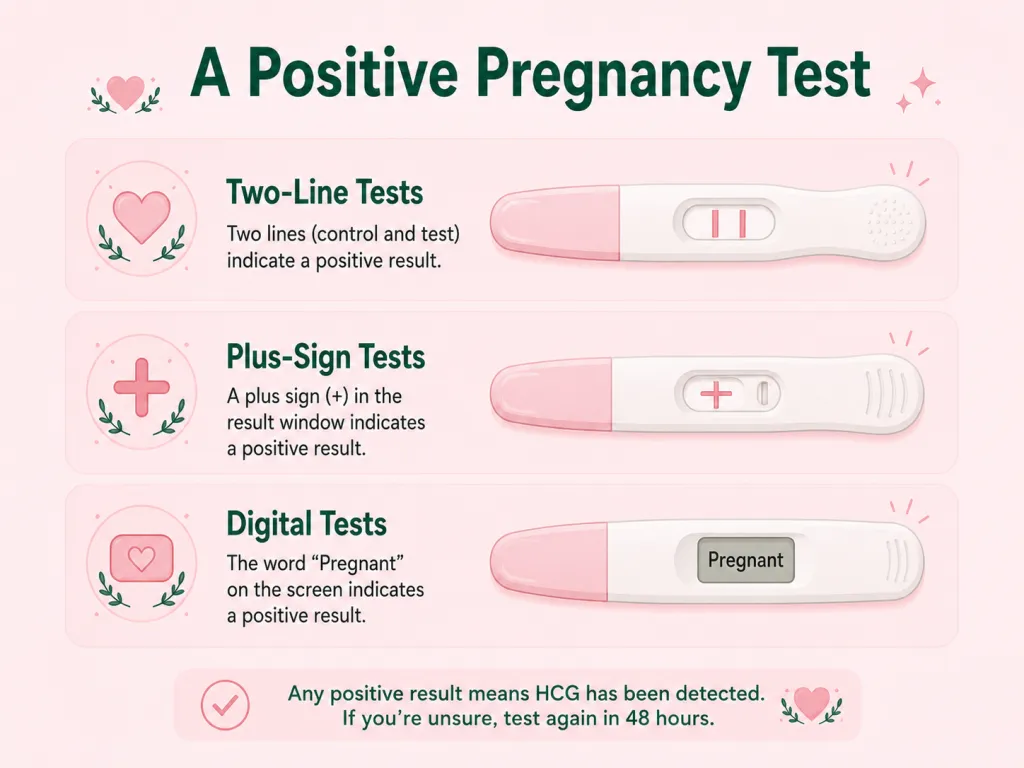
Two-Line Tests (Strips and Midstream)
On strip tests and midstream tests, a positive result shows up as a second visible line in the test window, alongside the control line. The color depends on the brand’s dye:
- Pink-dye tests (First Response, Natalist, Easy@Home) — the test line appears in a shade of pink.
- Blue-dye tests (Clearblue line tests, CVS and Target store brands) — the line appears blue.
An important thing to know: the test line does not need to match the darkness of the control line to count as positive. A thin, pale line running across the test area in the designated window is still a valid positive. What matters is that it’s the right color, in the right place, within the reading window.
Plus-Sign Tests
Some tests replace the two-line format with a plus sign. On these, a positive result appears as a “+” in the result window. A single horizontal line (or a minus sign, depending on the brand) means negative.
Common plus-sign tests include Clearblue Rapid Detection and First Response Rapid Result. One thing to watch for: even on plus-sign tests, the vertical line that completes the plus can sometimes appear faint in very early pregnancy. As long as there’s color forming a visible plus shape within the reading window, it counts.
Digital Tests
Digital tests take the guesswork out of reading lines. Instead of a line, a small screen displays “Pregnant” or “Not Pregnant” — and some, like Clearblue Digital with Weeks Indicator, also estimate how many weeks have passed since conception (1–2, 2–3, or 3+ weeks).
The trade-off is sensitivity. Digital tests are generally less sensitive than the best line tests. Research has shown home pregnancy test sensitivities varying from 5.5 mIU/mL (First Response) up to 22 mIU/mL for some digital devices, with corresponding differences in how many pregnancies each detected on the day of a missed period (Cole et al., ResearchGate). If a strip test shows a faint line but a digital reads “Not Pregnant,” the digital may just need another day or two of rising hCG.
What a Faint Positive Line Means
Here’s the rule most people need to hear: a faint colored line in the test window, appearing within the reading time, is a positive result. It means your body is producing hCG — just at a lower level than a fully developed positive line would show.
Faint lines are especially common when you’ve tested earlier than the day of your expected period, used an afternoon urine sample instead of first-morning urine, or when your hCG is still early in its rise — it doubles roughly every 48–72 hours in the first several weeks of pregnancy.
If you’re unsure whether a faint line is a real positive or an evaporation line — a colorless or gray mark that can appear after the test dries — the difference between a faint positive and an evaporation line comes down to color and timing. The short version: if the line has color and appeared within the reading window, it’s a positive.
When to Read a Pregnancy Test for Accurate Results
Timing is everything. Most home tests specify a reading window of 3 to 5 minutes, with a hard cutoff at 10 minutes. Any line that appears after that window is usually an evaporation line, not a real positive.
A few things that help you get an accurate read: use first-morning urine (when hCG is most concentrated), set a timer so you’re not guessing how long it’s been, and follow each brand’s specific instructions since reading windows vary slightly.
Testing too early is the other common pitfall. How soon after implantation you can test depends on how quickly your hCG rises above the test’s detection threshold — usually 6 to 12 days after implantation for most home tests.
Can a Positive Pregnancy Test Be Wrong?
False positives are rare but possible. The most common reasons a test can show positive when you aren’t pregnant (or aren’t still pregnant) include:
- Recent miscarriage or delivery — hCG can linger in your system for 6–8 weeks.
- Fertility medications containing hCG — trigger shots used in IVF or IUI can cause a positive reading.
- Chemical pregnancy — an early pregnancy that implants briefly but doesn’t continue; hCG rises and then falls.
- Ectopic pregnancy — the test reads positive because hCG is being produced, but the pregnancy is implanted outside the uterus and requires urgent medical attention.
What does not cause false positives: antibiotics, birth control pills, Plan B, or most common painkillers.
If you’ve gotten a positive and you’re unsure, a healthcare provider can order a quantitative beta-hCG blood test, which measures the exact hormone level and is significantly more sensitive than a home test.
What to Do After a Positive Pregnancy Test
A positive test is the beginning of the process, not the end of it. Your next steps:
- Schedule an appointment with your OB/GYN or primary care provider to confirm the pregnancy and begin prenatal care.
- Start a prenatal vitamin with folic acid if you haven’t already.
- Avoid alcohol, smoking, and any medications not cleared by your provider.
Newly pregnant readers often wonder how long after implantation hCG rises enough to sustain those pregnancy symptoms they’re starting to notice, and whether the light spotting before testing was implantation or a period — the two can look similar, but implantation bleeding and a period differ in timing, color, and duration. If you’re still in the two-week wait, counting days past ovulation (DPO) is the most reliable way to know when your test result will actually mean something.
Conclusion
A positive pregnancy test can look like two lines, a plus sign, or the word “Pregnant” on a digital screen — any visible colored line in the right window counts. Read the result inside the 3–5 minute reading window, trust faint lines that appear on time, and retest in 48 hours if you want a clearer confirmation.
The most important next step after any positive result is to schedule an appointment with your healthcare provider. A blood test will confirm the pregnancy and your provider can guide you through what comes next.
Frequently Asked Questions
How long does it take for a pregnancy test to show positive?
Most home pregnancy tests show a positive result within 3 to 5 minutes if hCG is present. Lines that appear after 10 minutes are usually evaporation lines, not real positives.
Can a pregnancy test be positive and then negative?
Yes — this can happen with a chemical pregnancy, where hCG rises briefly from an early implantation that doesn’t continue. It can also happen if the first test was read outside the time window. A blood test can clarify what’s going on.
How dark should the line be on a positive pregnancy test?
Any visible colored line in the test window within the reading time counts as positive. The line does not need to match the darkness of the control line to be valid.
Does a digital test confirm a line test positive?
Usually, but not always. Digital tests are often less sensitive than line tests, so a faint line test positive may still read “Not Pregnant” on a digital until hCG rises further. Retest with a digital in 48 hours for confirmation.
How early can a pregnancy test show a positive result?
The most sensitive home tests can detect pregnancy about 4 days before the day of your expected period, but accuracy improves significantly once you reach the day of or after your missed period. For reliable results, test with first-morning urine on or after the day your period was due.