Why Women Are More Likely to Be Diagnosed with Autoimmune Diseases
Autoimmune disorders or diseases occur when your body’s immune system malfunctions, leading to chronic inflammation, autoimmunity, or frequent infections. Essentially, your body is attacking its…
- Published
- Written by
- Women In Balance Team
- Reading time
- 3 minutes
Autoimmune disorders or diseases occur when your body’s immune system malfunctions, leading to chronic inflammation, autoimmunity, or frequent infections. Essentially, your body is attacking its healthy tissue.
Dozens of autoimmune disorders affect both men and women, including alopecia, Crohn’s, psoriasis, and celiac. However, it’s a well-known fact that women are more likely to be diagnosed with one than men. Keep reading to learn some of the most common reasons why:
Genetics
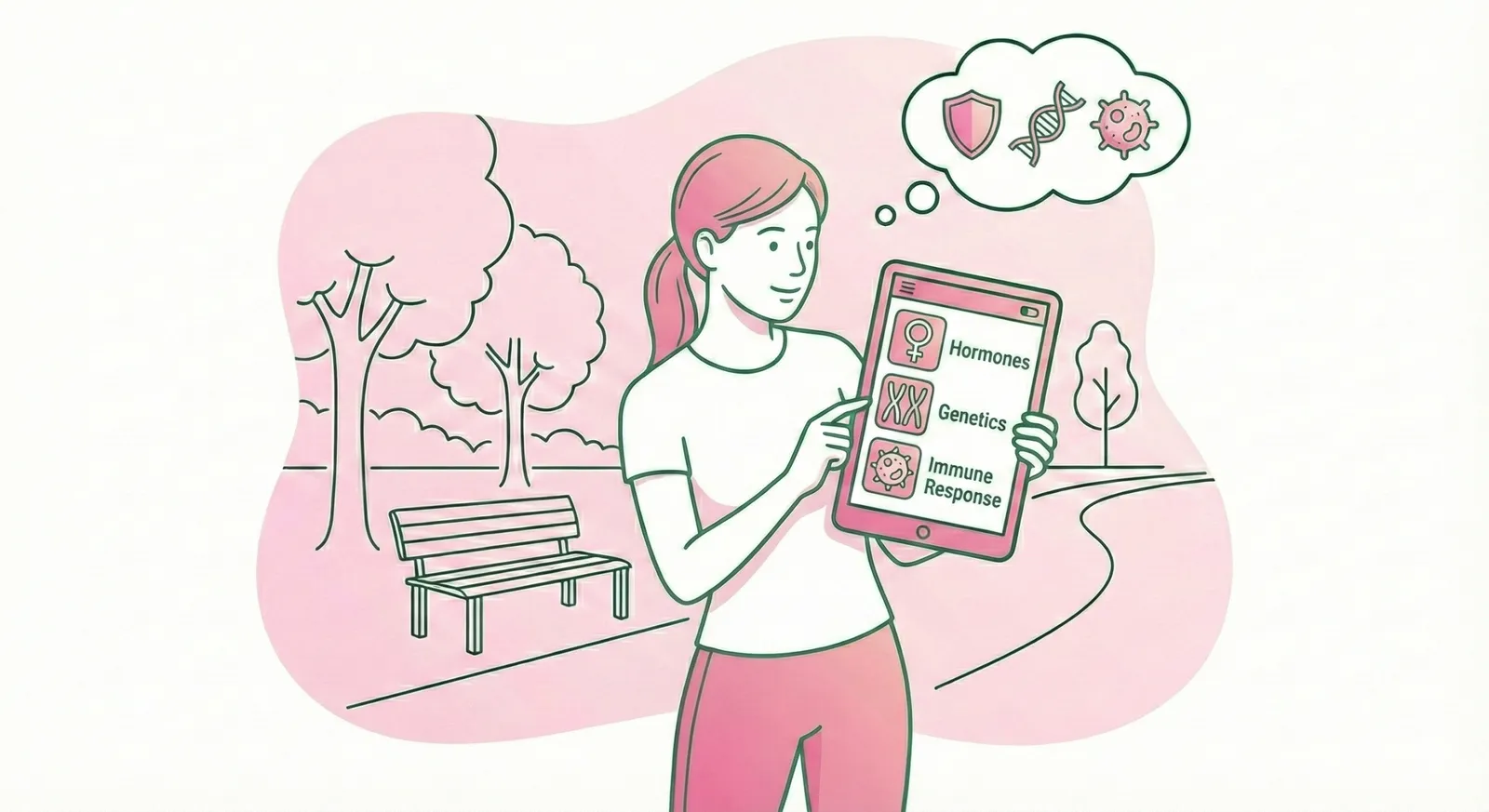
Ask any autoimmune disease doctor, and they’ll tell you that among the many contributing factors, genetic ones are some of the most common. Women have two X chromosomes, whereas men only have one. While the X chromosome in women is usually silenced in a process known as X chromosome inactivation, immune-related genes can ‘escape’ this silencing.
When the second X chromosome remains active, it results in a twofold increase in immune-related genes compared with men. As a result, our bodies can mistakenly attack their own tissues. While between 24 and 50 million Americans have an autoimmune disease, it’s believed that as many as four in five of them are women.
Hormones
Our hormones are responsible for a broad range of issues. When they aren’t balanced, we can experience physical, emotional, and cognitive problems stemming from natural life stages like puberty, menstruation, pregnancy, and menopause. Therefore, it’s perhaps not surprising to learn that hormones can also contribute to our risk of being diagnosed with an autoimmune disease.
In particular, estrogen can enhance cell activity. While this can make the immune system more robust, it can also contribute to overactivity. This means that your immune system can target its own tissues. A number of autoimmune diseases are influenced by estrogen, including rheumatoid arthritis, systemic lupus erythematosus (SLE), multiple sclerosis, and Graves’ disease.
Pregnancy and Childbirth
Pregnancy and childbirth already change our bodies in several ways, but putting us at risk of an autoimmune disease is likely not one you would have considered. Since the immune system changes during pregnancy, and antibody levels increase after childbirth, many new mothers receive autoimmune diagnoses.
Throughout pregnancy and childbirth, there are many dramatic yet necessary changes. The first is immune suppression, in which the maternal immune system is modified to be more ‘tolerant’ so it doesn’t reject the fetus.
After childbirth, hormone levels plummet, and the immune system quickly returns to its normal, pre-pregnancy state. However, the sudden change can cause heightened immune vigilance. This increases the chance of an autoimmune response in which the body mistakenly attacks its own healthy tissues.
Stress
Numerous studies have found that women experience consistently higher stress levels than men. Stress-based disorders are more common in women, and women tend to have quicker, longer, and more significant stress responses than men.
As stress itself wasn’t bad enough to manage, women also have to deal with the knowledge that their higher stress levels may also increase their risk of autoimmune diseases. Chronic stress can disrupt our immune regulation. As a result, it may trigger and exacerbate autoimmune diseases.
According to the Global Autoimmune Institute, up to 80% of patients reported emotional stress before the onset of disease. They also stated that within a study of over 100,000 people with stress-related disorders, they were more likely to be diagnosed with one or multiple autoimmune diseases compared to their siblings and another million people without stress-related disorders.
Environmental Exposures
It may seem unusual that environmental exposure can put you at an increased risk of an autoimmune disease as a woman, but it’s possible. Autoimmune diseases require two things: genetic susceptibility and an environmental trigger. Women are more likely to encounter or biologically react to specific triggers. The many everyday chemicals we come into contact with interfere with hormones and immune signaling, such as:
- Cosmetics
- Hair products
- Skincare products
- Household cleaning products
- Fragrances and perfumes
- Plastics
These chemicals can block or mimic estrogen, and estrogen directly affects our immune cells. When the signals are disrupted, they can push our immune system toward autoimmunity or chronic inflammation. Beyond environmental exposures, women also face occupational exposures. Some jobs with higher female participation involve immune-triggering exposures, such as:
- Pathogens, disinfectants, and latex in healthcare
- Recurrent infections in education and childcare
- Solvents and acrylics in nail salons and hair salons
- Harsh chemicals in cleaning businesses
Even the medications we take to heal and manage other illnesses and conditions can trigger autoimmunity in predisposed women, such as antibiotics, hormonal contraceptives, and interferons.
You can feel alone when you’re living with an autoimmune disease. However, as a woman, you’re not alone. Millions like you will receive the same diagnoses simply due to the gender they were born with.