Can Twins Cause a False Negative Pregnancy Test? The Hook Effect Explained
Key Takeaways You’re feeling all the early pregnancy symptoms — exhausted, nauseous, tender breasts, a missed period — but your home pregnancy test keeps coming back negative. You’ve read somewhere…
- Published
- Written by
- Women In Balance Team
- Reading time
- 7 minutes

Key Takeaways
- Yes, twins can occasionally cause a false negative pregnancy test through the hook effect, where extremely high hCG levels overwhelm the test’s antibodies and prevent a positive reading. But it’s rare in early pregnancy.
- The hook effect typically requires hCG levels above ~500,000 mIU/mL, which usually only occur later in the first trimester. Most early-pregnancy false negatives come from testing too early.
- If you suspect pregnancy despite negative home tests, the most reliable next step is a quantitative beta-hCG blood test ordered by a healthcare provider — it isn’t fooled by the hook effect in the same way.
You’re feeling all the early pregnancy symptoms — exhausted, nauseous, tender breasts, a missed period — but your home pregnancy test keeps coming back negative. You’ve read somewhere online that twins can cause a false negative. Could that be it?
Here’s the honest answer up front: yes, twins can occasionally cause a false negative pregnancy test through a phenomenon called the hook effect — but it is rare, and it almost never happens during the standard early-pregnancy testing window. The hook effect requires extremely high hCG levels that don’t typically appear until later in the first trimester. Most early-pregnancy negative tests have a much simpler explanation: the test was taken too early. This article walks through how the hook effect actually works, when it can happen, and what to do if you suspect pregnancy despite repeated negative tests.
Can Twins Cause a False Negative Pregnancy Test?
Yes, twins can occasionally cause a false negative pregnancy test, but it’s rare and only happens at very high hCG levels. Twin pregnancies produce more hCG than singleton pregnancies — typically 30 to 50% higher at the same gestational age. At extremely high concentrations, this excess hCG can interfere with home pregnancy tests in a specific way called the hook effect.
Here’s the important context: the hook effect doesn’t usually happen during the standard early-pregnancy testing window. In early pregnancy, hCG is in the hundreds to low thousands — far below the level that would saturate a test. The hook effect is much more common later in the first trimester (around weeks 7–13), when hCG hits its natural peak.
So if you’re testing in the first few weeks after a missed period and getting negative results, the hook effect is almost certainly not the explanation. Other causes are far more likely — and we’ll cover those further down.
What Is the Hook Effect on a Pregnancy Test?
The hook effect, also called the high-dose hook effect or prozone phenomenon, is a known limitation of certain immunoassay tests where extremely high concentrations of a target hormone produce a falsely low or negative result. It’s not a defect — it’s a well-documented quirk of how these tests are designed.
Here’s the mechanism, without the jargon. A pregnancy test relies on two antibodies that need to grab onto the same hCG molecule and form a “sandwich” complex — like two hands meeting around a single piece of paper. When hCG is in normal ranges, this works fine. But at extremely high concentrations, both antibodies get separately saturated by different hCG molecules — each hand holds its own piece, but they never meet. Without that complete sandwich, the test reads negative even though hCG is everywhere in the sample.
A case report published in Oxford Medical Case Reports puts the threshold concretely: when hCG levels exceed approximately 500,000 mIU/mL, both antibodies saturate, and the test produces a falsely low or negative result. For comparison, hCG in early pregnancy at 4 weeks is typically only 100 to a few hundred mIU/mL — three to four orders of magnitude below the hook-effect threshold.
There’s also a rarer variation called the variant hook effect, where unusual hCG variants interfere with the antibodies even at less extreme concentrations.
When Does the Hook Effect Cause a False Negative Pregnancy Test?
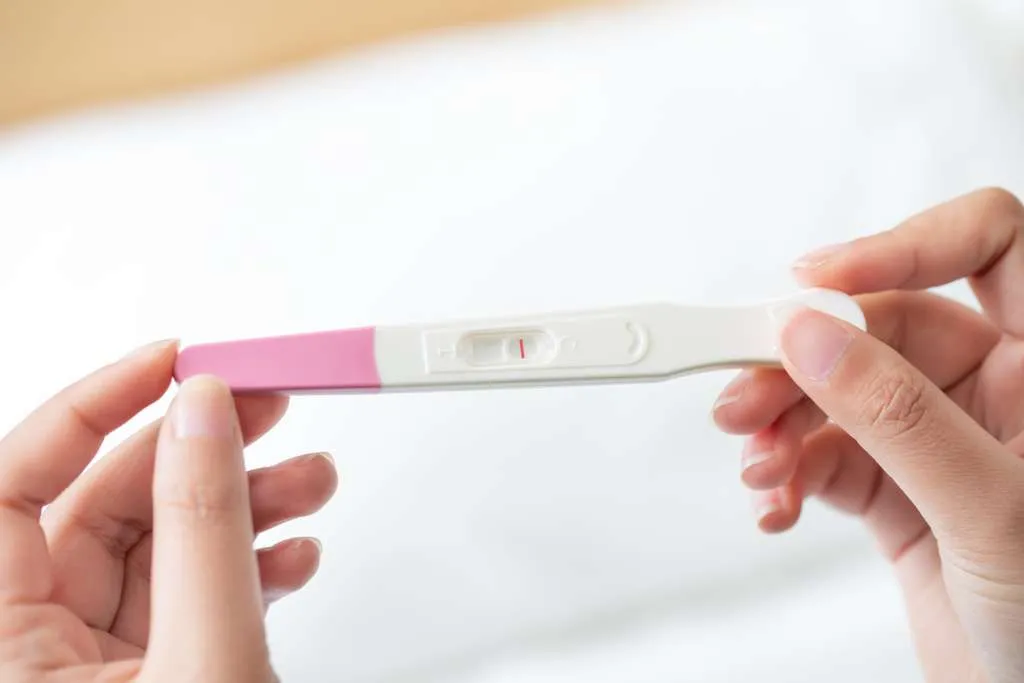
In real pregnancies, the hook effect is most likely:
- In the second half of the first trimester (around weeks 7–13), when hCG is at its natural peak.
- In twin or higher-order multiple pregnancies, where hCG runs higher than in singletons.
- In molar pregnancies, where abnormal trophoblastic tissue produces extremely high hCG. Most published case reports of the hook effect actually come from molar pregnancies, not normal twin pregnancies.
- In certain hCG-producing tumors, which are rare but documented.
What’s worth saying clearly: the hook effect is rare in normal twin pregnancies during the early testing window. It’s far more frequently reported in molar pregnancies, where hCG climbs to abnormal levels quickly. In a normal twin pregnancy, your hCG might be 30–50% higher than a singleton’s, but that’s still well within the range a home test can detect — until you get to the late first trimester.
Other Reasons for a Negative Pregnancy Test in Early Pregnancy
Most negative home pregnancy tests in early pregnancy aren’t caused by hidden twin pregnancies. The likelier explanations:
- Testing too early. This is the single most common cause. hCG hasn’t reached the test’s detection threshold yet (typically around 25 mIU/mL). A few days of hCG rising after implantation can be the difference between a negative and a clear positive.
- Diluted urine. Testing in the afternoon or evening rather than first-morning urine can dilute hCG enough to miss it on a borderline result.
- Late or irregular ovulation. If your cycle was off, your testing timing was off too. Counting days past ovulation (DPO) is more reliable than counting from your last period — most women who would test positive can do so by 10 DPO, but some need a few extra days.
- A genuine non-pregnancy explanation. Period delays from stress, weight changes, thyroid issues, PCOS, and perimenopause are common.
- An unclear or evaporation line. If you saw a faint line that you weren’t sure about, the difference between a faint positive and an evaporation line comes down to color and timing.
If you’ve been getting consistent negatives but your period still hasn’t come, how soon after implantation you can test covers when hCG actually becomes detectable. Often the answer is to wait a few more days and retest with first-morning urine.
How to Confirm Pregnancy After a Negative Home Test
The most reliable way to confirm pregnancy when home tests aren’t giving you clarity is a quantitative beta-hCG blood test, ordered by a healthcare provider. Blood tests are significantly more sensitive than home urine tests, and a quantitative beta-hCG gives an exact hormone level rather than a yes/no.
A practical sequence:
- Wait until at least the day of your expected period to retest at home, using first-morning urine. Testing earlier produces unreliable results.
- If still negative but symptoms persist, retest in 48 to 72 hours. hCG roughly doubles in that window in early pregnancy, so a clearer result usually appears.
- If you’ve missed two or more periods or have strong pregnancy symptoms despite negative home tests, see a healthcare provider. A blood test and possibly an ultrasound can resolve the question definitively.
For suspected hook effect specifically, a clinician can dilute the urine sample — a 1:10 or even 1:100 dilution — which counterintuitively lets the test read positive by reducing the antigen-to-antibody ratio. This is sometimes done in a clinical setting when symptoms strongly suggest pregnancy but home tests are negative.
When to See a Doctor About a Negative Pregnancy Test
Book an appointment with a healthcare provider if any of these apply:
- You have strong pregnancy symptoms despite repeated negative home tests.
- You’ve missed two or more periods with no clear non-pregnancy explanation.
- You have a history of fertility treatment or twins in your family, combined with persistent symptoms.
- You’re experiencing severe abdominal or pelvic pain, dizziness, or fainting — these can indicate ectopic pregnancy and are urgent.
- You have heavy vaginal bleeding outside a normal period.
A quantitative beta-hCG blood test takes only a few hours to come back and provides a definitive answer. If you’ve been testing at home for weeks and getting nothing useful, a single blood draw will resolve it.
Final Thoughts on Twins and False Negative Pregnancy Tests
Yes, twins can cause a false negative pregnancy test through the hook effect — but it’s a rare, late-first-trimester phenomenon, not a typical early-pregnancy issue. Most negative home tests in early pregnancy come down to testing too early, not hidden twins.
If you suspect you’re pregnant despite negative home tests, schedule a blood test with a healthcare provider. That’s the only way to know for certain — and a beta-hCG blood test isn’t fooled by the hook effect the way home urine tests can be.
Frequently Asked Questions
How common is the hook effect with twin pregnancies?
The hook effect is rare even in twin pregnancies. It typically requires hCG levels above ~500,000 mIU/mL, which mostly occur later in the first trimester. Most published case reports of the hook effect involve molar pregnancies rather than normal twin pregnancies.
Can a blood test detect twins when a home test is negative?
Yes. A quantitative beta-hCG blood test is significantly more sensitive than home urine tests, and clinicians can also dilute samples to overcome the hook effect if it’s suspected. If there’s any reason to suspect pregnancy, a blood test gives a definitive answer.
If my home test is negative but I think I’m pregnant, what should I do?
Retest in 48 to 72 hours with first-morning urine. If you’re still getting negatives but symptoms persist or your period hasn’t come, see a healthcare provider for a blood test and possibly an ultrasound — that’s the most reliable way to confirm.