The 4 Stages of Implantation: Timing, Symptoms, and What’s Happening
Key Takeaways If you’re in the two-week wait or post-IVF transfer, the question on your mind is probably some version of: what’s actually happening in there? The 4 stages of implantation are the…
- Published
- Written by
- Women In Balance Team
- Reading time
- 8 minutes
Key Takeaways
- The 4 stages of implantation are apposition (loose attachment around day 6-7 after fertilization), adhesion (firmer attachment around day 7-8), invasion (the blastocyst burrows into the uterine lining around day 8-10), and placentation (the primitive placenta forms from day 10-12 onward).
- The entire implantation process takes about 4-5 days from start to finish, with implantation generally considered complete by day 12-14 after fertilization. For IVF patients, the same stages occur on a compressed timeline starting from the day of embryo transfer.
- Most women feel nothing during implantation. The “symptoms” some women experience — light cramping, spotting — happen mainly during invasion (stage 3) and aren’t reliable confirmation that implantation succeeded. A pregnancy test taken at 10-14 days past ovulation is the most reliable way to confirm.
If you’re in the two-week wait or post-IVF transfer, the question on your mind is probably some version of: what’s actually happening in there? The 4 stages of implantation are the medically defined sequence of events that turn a fertilized egg into an established pregnancy. They unfold microscopically over about 4-5 days and are largely silent — most women feel nothing at all during the implantation process.
The 4 stages follow a strict order: apposition (the blastocyst makes loose contact with the uterine wall), adhesion (molecular bonds lock it in place), invasion (the embryo burrows into the uterine lining), and placentation (the primitive placenta begins forming). This article walks through what happens at each stage, the timing in both natural and IVF cycles, and what — if anything — you might feel along the way.
The 4 Stages of Implantation
The stages of implantation are clinically defined and follow a strict sequence. Implantation typically occurs 6 to 12 days after ovulation, with peak activity around day 8 to 10. The full 4-stage process takes about 4 to 5 days from start to finish.
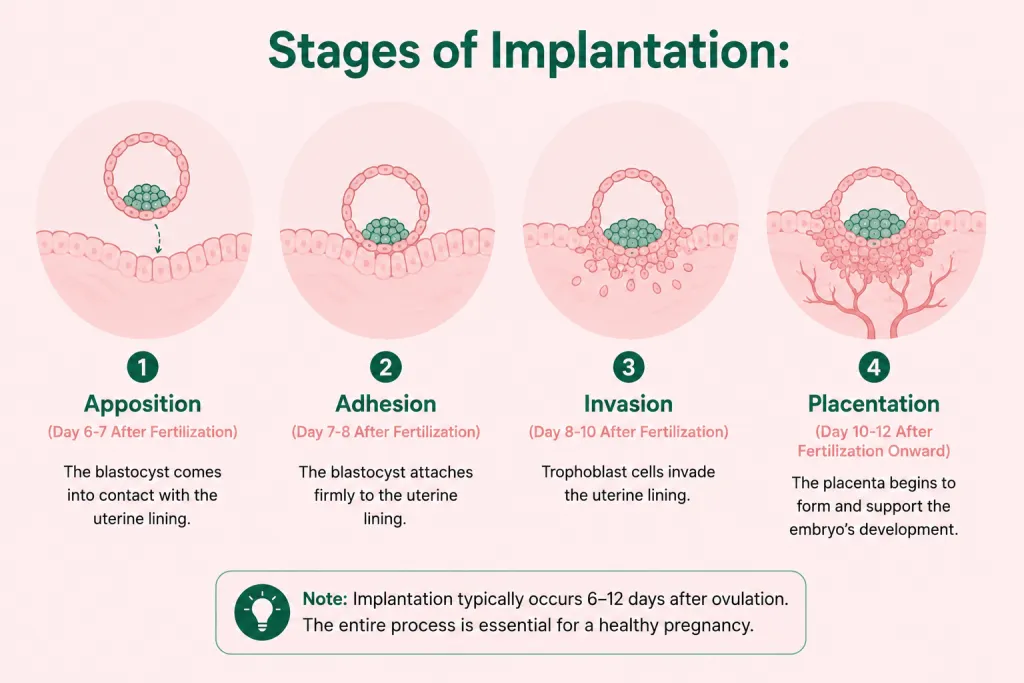
1. Apposition (Day 6-7 After Fertilization)
What happens: the blastocyst — at this point a ball of roughly 150 cells — makes its first loose contact with the uterine wall. The contact isn’t firm yet. The blastocyst can still “roll” along the endometrial surface, looking for the right spot.
Cycle timing: apposition happens during the “window of implantation” — the receptive phase of the endometrium, typically cycle days 19 to 23 in a 28-day cycle.
IVF equivalent: ~day 1 to 2 after a day-5 blastocyst transfer.
What you might feel: nothing. Apposition is too subtle to produce noticeable sensations.
Why it matters: this is the trial-run stage. If the endometrium isn’t receptive — meaning it isn’t in the right hormonal state to receive the blastocyst — implantation may not progress further. Per a peer-reviewed review on PMC, the cellular adhesion molecules that drive this stage (integrins, cadherins, selectins) only function during a specific receptive window.
2. Adhesion (Day 7-8 After Fertilization)
What happens: molecular bonds form between the blastocyst and the uterine wall, locking it in place. Adhesion proteins on both sides engage with each other. The blastocyst orients with its inner cell mass (which will become the embryo) facing into the uterus, and its trophoblast cells (which will become the placenta) facing outward.
Cycle timing: continues during the window of implantation, typically cycle days 20 to 24.
IVF equivalent: ~day 2 to 3 after a day-5 blastocyst transfer.
What you might feel: still typically nothing. Some women report very subtle changes — but most don’t.
Why it matters: this is the point of no return from a positional standpoint. The blastocyst is now committed to that spot in the uterine wall and cannot be dislodged by normal fluid movement in the uterus.
3. Invasion (Day 8-10 After Fertilization)
What happens: the trophoblast cells of the blastocyst burrow into the endometrium, embedding the blastocyst fully in the uterine wall. The trophoblast differentiates into syncytiotrophoblast — a specialized cell layer that secretes enzymes to break down maternal tissue and create space for the developing embryo.
Cycle timing: typically cycle days 22 to 24, often around the time a woman would expect her next period.
IVF equivalent: ~day 3 to 5 after a day-5 blastocyst transfer.
What you might feel: this is the stage most commonly associated with implantation symptoms. Some women notice what implantation cramps feel like — typically mild, central, intermittent — or light spotting that differs from a regular period in implantation bleeding. Most women feel nothing even during invasion.
Why it matters: hCG production begins in earnest during invasion. The article on how hCG rises after implantation walks through the rise pattern. hCG first becomes detectable in blood around day 8 to 10 and in urine around day 10 to 14 — which is the window when you can test after implantation with reasonable accuracy.
4. Placentation (Day 10-12 After Fertilization Onward)
What happens: the primitive placenta begins forming as trophoblast cells continue invading and encounter maternal blood vessels. They remodel these vessels into low-resistance channels that will eventually supply the developing fetus with oxygen and nutrients. The surrounding endometrium transforms into decidua — specialized maternal tissue that supports the pregnancy.
Cycle timing: typically cycle day 24 onward, often after a missed period.
IVF equivalent: ~day 5 and onward after a day-5 blastocyst transfer.
What you might feel: typical early pregnancy symptoms may start to emerge — breast tenderness, fatigue, mild nausea — driven by rising hCG and progesterone. The earliest symptoms are usually mild and easy to mistake for PMS.
Why it matters: by around day 12 to 14 after fertilization, implantation is considered complete. Early pregnancy is established. From here, the embryo begins rapid development and the placenta continues maturing over the first trimester.
Implantation Timing in Context
The implantation timeline maps cleanly onto cycle landmarks for women trying to conceive naturally. Tracking days past ovulation (DPO) is the most reliable way to know where you are in the implantation process — counting from ovulation is more accurate than counting from your last period, especially if your cycles vary. The article on what to expect at 10 DPO covers the day most associated with the invasion stage and earliest detectable hCG rise.
Implantation efficiency is a worth-knowing number: approximately 50 to 60% of fertilized eggs successfully complete all 4 stages and establish a pregnancy. Failures at the apposition or adhesion stage are common and often go entirely unnoticed — sometimes called a “chemical pregnancy” when failure is detected only by an early positive test that doesn’t progress.
For IVF patients, the same 4 stages of implantation occur but on a compressed and predictable timeline starting from the day of transfer. Most IVF clinics schedule a beta-hCG blood test 9 to 14 days post-transfer to assess whether implantation has succeeded.
Can You Feel Implantation Happening?
The honest answer: most women feel nothing during the implantation process. The 4 stages are microscopic events. The “implantation symptoms” you’ll read about online happen in only some women and aren’t reliable confirmation that any specific stage is occurring.
The sensations some women do report are mostly tied to the invasion stage (day 8-10):
- Light cramping, typically mild and central
- Light spotting or pink/brown discharge
- Slight bloating or breast tenderness
These symptoms overlap heavily with normal luteal phase changes, which is why the two-week wait is full of signals that can be interpreted as “implantation” but are often just PMS. The distinguishing feature of implantation bleeding versus a normal period is its lightness — typically just a few drops over 1 to 3 days, often pink or brown rather than red.
When You Can Confirm Implantation With a Pregnancy Test
hCG production starts during invasion (stage 3) but takes a few days to reach detectable levels in urine. The reliable testing window is:
- Blood beta-hCG tests: detectable at roughly 8 to 10 days after fertilization
- Home pregnancy tests (urine): most reliable at 12 to 14 days after fertilization — corresponding to the day of expected period or just after
Testing too early can produce a false negative even when implantation has succeeded. The article on what a positive pregnancy test looks like covers what to expect when you do test. Once you have a confirmed positive, an early ultrasound around 6 to 8 weeks confirms an intrauterine pregnancy and rules out concerns like signs of ectopic pregnancy.
Putting the Stages Together
The 4 stages of implantation — apposition, adhesion, invasion, and placentation — unfold microscopically over about 4 to 5 days, typically starting 6 to 7 days after ovulation and finishing around day 12 to 14. The whole process is largely invisible from the outside. Most women feel nothing, and the symptoms that show up in only some women aren’t reliable confirmation that implantation has succeeded.
If you’re trying to conceive, wait until at least 12 to 14 days past ovulation before testing for the most accurate result. If you’ve had an IVF transfer, follow your clinic’s testing schedule — typically a beta-hCG blood test 9 to 14 days post-transfer.
Frequently Asked Questions
How long does the implantation process take?
The full 4-stage implantation process takes about 4 to 5 days from the first contact (apposition) to placentation establishment. Implantation typically starts 6 to 7 days after fertilization and is considered complete by day 12 to 14.
Can implantation fail at any of the 4 stages?
Yes. Implantation fails most commonly at the apposition or adhesion stage and often goes unnoticed. Approximately 50 to 60% of fertilized eggs successfully complete all 4 stages, while the rest fail at one of the earlier stages — sometimes called a chemical pregnancy when detected by an early positive test that doesn’t progress.
What does implantation feel like at each stage?
Most women feel nothing during any of the 4 stages of implantation. Some women experience mild central cramping or light spotting during the invasion stage (day 8 to 10), but these symptoms aren’t reliable indicators that implantation is occurring — they overlap heavily with normal luteal phase changes.